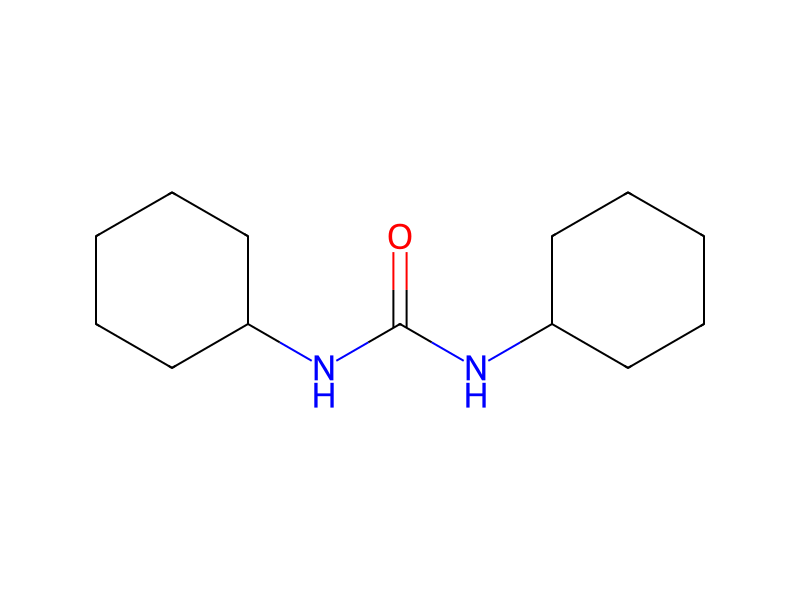
Dicyclohexylcarbodiimide → N,N'-Dicyclohexylurea
Reaction equation
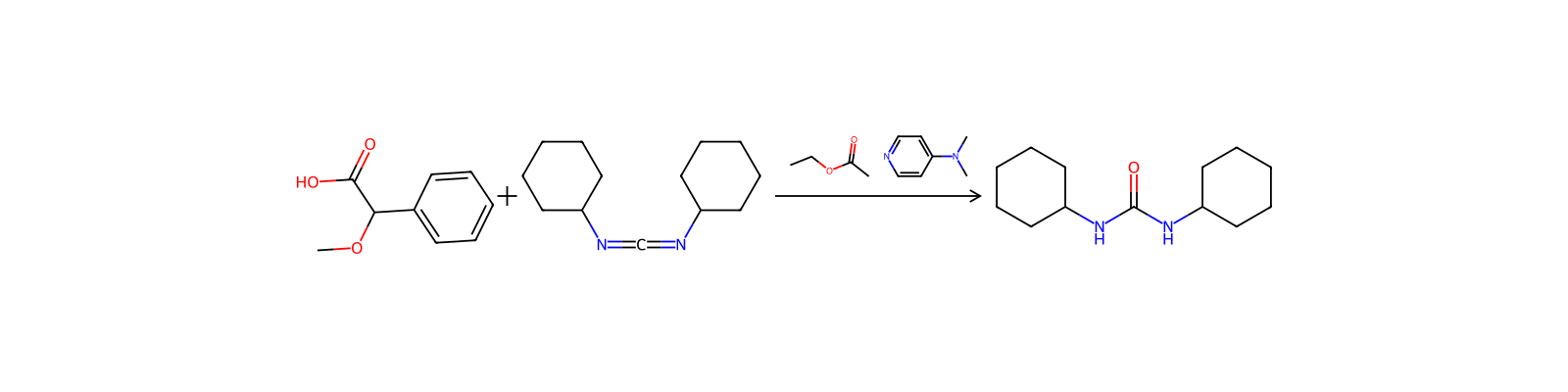
C[O:2]C(C1C=CC=CC=1)C(O)=O.[CH:13]1([N:19]=[C:20]=[N:21][CH:22]2[CH2:27][CH2:26][CH2:25][CH2:24][CH2:23]2)[CH2:18][CH2:17][CH2:16][CH2:15][CH2:14]1>C(OCC)(=O)C.CN(C)C1C=CN=CC=1>[CH:22]1([NH:21][C:20]([NH:19][CH:13]2[CH2:14][CH2:15][CH2:16][CH2:17][CH2:18]2)=[O:2])[CH2:27][CH2:26][CH2:25][CH2:24][CH2:23]1Participants
Reactant 2


Product 1
Reagents, catalysts & solvents 2


Procedure
In 50 ml of ethyl acetate was dissolved with heating 1.0 g (2.73 mmole) of the compound obtained in step 1 of Example 1 above. To the resultant solution were added 0.68 g (4.10 mmole) of (-)-α-methoxyphenylacetic acid and then 0.67 g (3.28 mmole) of 1,3-dicyclohexyl carbodiimide at room temperature. Subsequently, 0.040 g (0.33 mmole) of 4-dimethylaminopyridine as a catalyst was added. The resultant mixture was stirred for 24 hours. Dicyclohexyl urea in the form of a white solid produced during the reaction as a side-product was removed by filtration, and the remaining filtrate was concentrated and purified by silica gel column chromatography using a mixture of hexane and ethyl acetate (1:1) as an eluent to obtain 0.70 g (1.36 mmole, yield 50%) of (+) dimethoxymethyl-3-(O-α-methoxy-α-phenylacethoxy)-4-(2'-oxo-1'-pyrrolidinyl)-6-cyano-3,4-dihydro-2H-1-benzopyran having Rf value of 0.23 and 0.54 g (1.05 mmole, yield 38%) of (-) dimethoxymethyl-3-(O-α-methoxy-α-phenylacethoxy)-4-(2'-oxo-1'-pyrrolidinyl)-6-cyano-3,4-dihydro-2H-1-benzopyran having Rf value of 0.30.
Workup
- customat room temperature
Sources & evidence
- ORD record
- ord-bfab771b5f6949a5a852f2d2e7881774
- Source dataset
- uspto-grants-1993_08
- Patent number
- US05236935
Reaction notes
Loading…