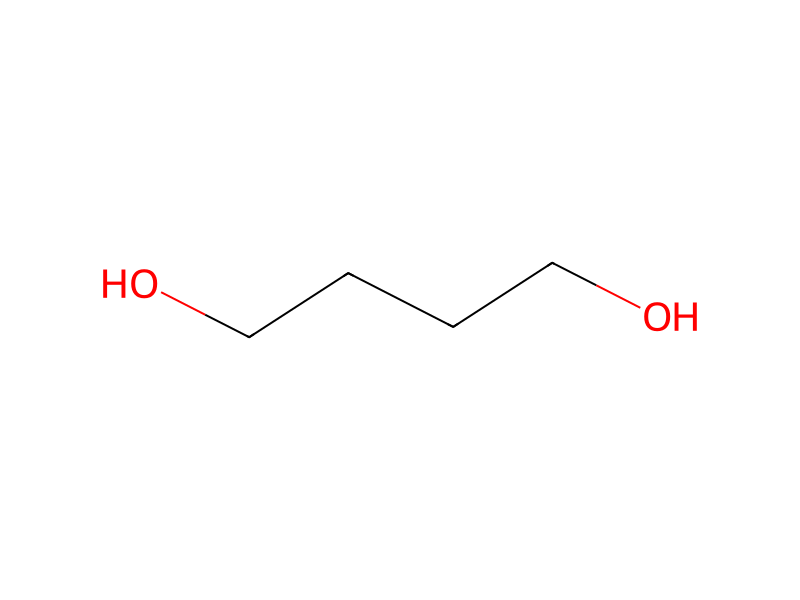
1,4-Butanediol → Phenyl isocyanate
Reaction equation

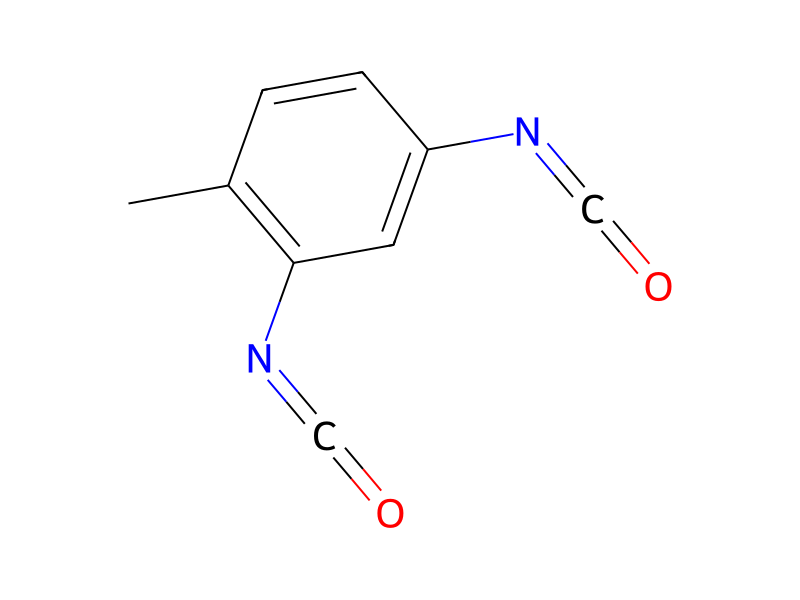
C(OC)(=O)C1C=CC(C(OC)=O)=CC=1.C(O)CCCO.C[C:22]1[CH:27]=[CH:26][C:25]([N:28]=[C:29]=[O:30])=[CH:24][C:23]=1N=C=O>CC(C)[O-].CC(C)[O-].CC(C)[O-].CC(C)[O-].[Ti+4]>[C:25]1([N:28]=[C:29]=[O:30])[CH:26]=[CH:27][CH:22]=[CH:23][CH:24]=1Participants
Reactant 3

Product 1

Reagents, catalysts & solvents 1

Conditions
- Temperature
- 210 °C
Procedure
In a 1 liter three-necked resin flask equipped with nitrogen inlet and outlet, thermometer, condenser and mechanical stirrer, were placed 194 grams (1 moles) of dimethyl terephthalate, 207 grams (2.3 moles) of 1,4-butanediol and 0.173 grams of titanium tetraisopropoxide. The mixture was heated at 210° C. for 2 hours while distilling out methanol. The resulting mixture was heated at 250° C. for 30 minutes, and then vacuum was applied for 3 hours. After vacuum was released and replaced with nitrogen, 2,4-toluenediisocyanate (5.48 grams, 0.0314 moles) was added into the flask. The resulting polymer was stirred for 10 minutes at 250° C., and then was cooled to room temperature to obtain phenyl isocyanate terminated copolyester with an intermediate molecular weight, I.V. 1.98 dL/g as determined at 25° C. and 0.1% concentration in HFIP/PFP 50/50; Tmp 220° C.; heat of fusion 37 j/g; Tg 47° C.
Workup
- customIn a 1 liter three-necked resin flask equipped with nitrogen inlet and outlet
- customthermometer, condenser and mechanical stirrer, were placed
- distillationwhile distilling out methanol
- temperatureThe resulting mixture was heated at 250° C. for 30 minutes
- additionwas added into the flask
- temperaturewas cooled to room temperature
Sources & evidence
- ORD record
- ord-b959c58c52e348709e1037bc3af41473
- Source dataset
- uspto-grants-1997_08
- Patent number
- US05654097
Reaction notes
Loading…