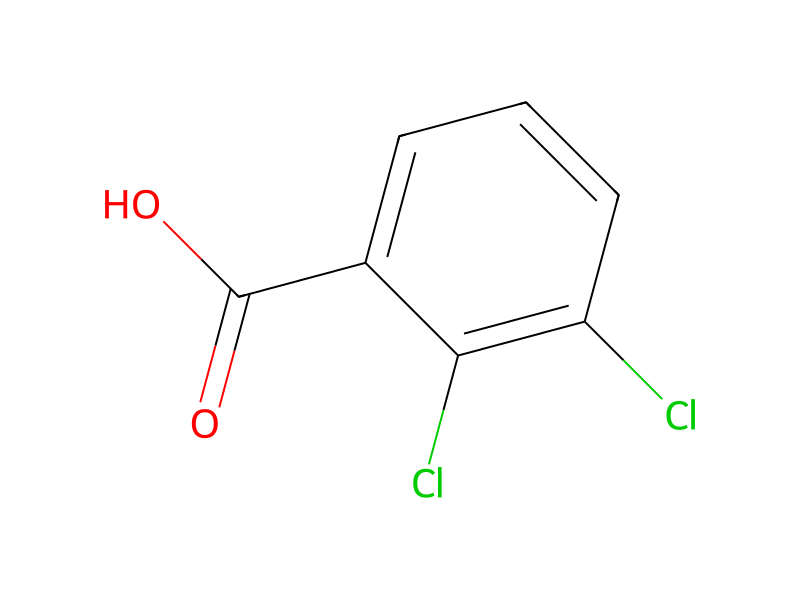
Acetic Acid → 2,3-Dichlorobenzoic acid
Reaction equation

[Br-].[Na+].[Cl:3][C:4]1[C:5]([Cl:11])=[C:6]([CH3:10])[CH:7]=[CH:8][CH:9]=1.OO.[C:14]([OH:17])(=[O:16])[CH3:15]>O.O.O.O.C([O-])(=O)C.[Co+2].C([O-])(=O)C>[Cl:3][C:4]1[C:5]([Cl:11])=[C:6]([CH:7]=[CH:8][CH:9]=1)[CH:10]=[O:16].[Cl:3][C:4]1[C:5]([Cl:11])=[C:15]([CH:7]=[CH:8][CH:9]=1)[C:14]([OH:17])=[O:16]Participants
7
Reactant 4



Product 2

Reagents, catalysts & solvents 1

Procedure
The procedure of Example I was repeated, but this time cobalt (II) acetate tetrahydrate (0.012 moles), sodium bromide (0.05 moles), dichlorotoluene (0.074 moles), acetic acid (100 g) and hydrogen peroxide (70%, 0.68 moles) were used and the reaction was performed at 90° C. for three hours. The final reaction mixture, analysed by HPLC, revealed that 66.0% of the dichlorotoluene had been consumed, yielding products including dichlorobenzaldehyde (15.2% yield) and dichlorobenzoic acid (23.8% yield).
Workup
- customThe final reaction mixture
- customhad been consumed
- customyielding products
Sources & evidence
- ORD record
- ord-2f3c76ec3bdf4706a3d7f16e909691e8
- Source dataset
- uspto-grants-1995_12
- Patent number
- US05473101
Reaction notes
Loading…