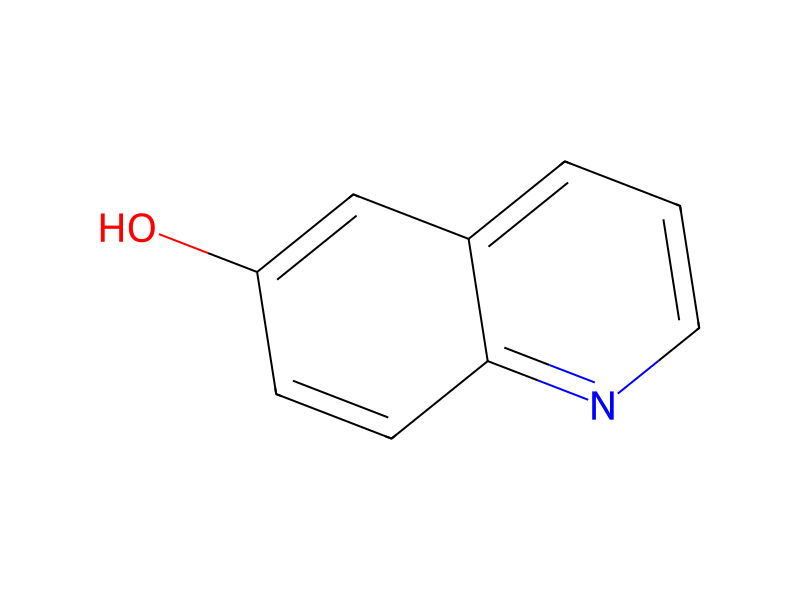
6-Hydroxyquinoline → 6-(6-Chloropyrimidin-4-yloxy)quinoline
Reaction equation

Cl[C:2]1[CH:7]=[C:6]([Cl:8])[N:5]=[CH:4][N:3]=1.[OH:9][C:10]1[CH:11]=[C:12]2[C:17](=[CH:18][CH:19]=1)[N:16]=[CH:15][CH:14]=[CH:13]2.[OH-].[Na+]>O.CC(C)=O>[Cl:8][C:6]1[N:5]=[CH:4][N:3]=[C:2]([O:9][C:10]2[CH:11]=[C:12]3[C:17](=[CH:18][CH:19]=2)[N:16]=[CH:15][CH:14]=[CH:13]3)[CH:7]=1Participants
5
Reactant 3


Product 1

Reagents, catalysts & solvents 1

Procedure
A solution of 7.45 g (50 mMol) of 4,6-dichlor-pyrimidine, 7.64 g (50 mMol) of 6-hydroxy-chinolin and 2.0 g (50 mMol) NaOH dissolved in 200 ml of H2O/acetone 1:1 is stirred for 3 h. The resulting solid is filtered off, washed with H2O/acetone ans dried: m.p.: 136-137° C.; MS: [M+1]+=258.
Workup
- filtrationThe resulting solid is filtered off
- washwashed with H2O/acetone ans
- customdried
Sources & evidence
- ORD record
- ord-61fc11e1f7434d909c5b74ea45bc281c
- Source dataset
- uspto-grants-2010_12
- Patent number
- US07855215B2
Reaction notes
Loading…