Benzoyl chloride, 3-bromo- → HCID 59596311, compound
Reaction equation

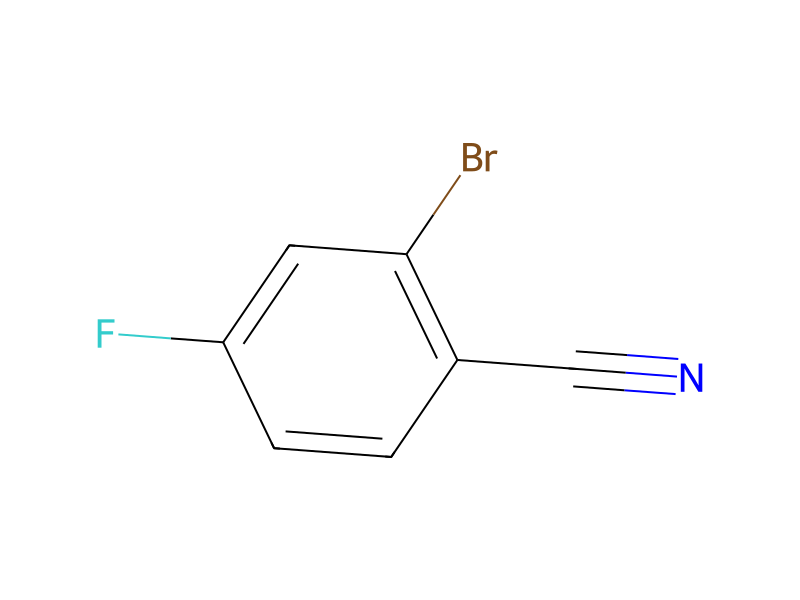
Br[C:2]1[CH:9]=[C:8]([F:10])[CH:7]=[CH:6][C:3]=1[C:4]#[N:5].[Br:11][C:12]1[CH:13]=[C:14]([CH:18]=[CH:19][CH:20]=1)[C:15](Cl)=[O:16]>O1CCCC1.[Zn]>[Br:11][C:12]1[CH:13]=[C:14]([CH:18]=[CH:19][CH:20]=1)[C:15]([C:2]1[CH:9]=[C:8]([F:10])[CH:7]=[CH:6][C:3]=1[C:4]#[N:5])=[O:16]Participants
Reactant 2

Product 1

Reagents, catalysts & solvents 2


Procedure
A 0.1 g/mL suspension of highly activated zinc powder in tetrahydrofuran (33 mL, 50 mmol) was transferred via cannula to a solution of 2-bromo-4-fluorobenzonitrile (5.0 g, 25 mmol) in anhydrous tetrahydrofuran (100 mL) at room temperature under an atmosphere of argon. The mixture was stirred at room temperature for 5 h and then sonicated with ultrasound for 30 min. The excess zinc was allowed to settle over night at −20° C. The solution on top was transferred via cannula to another flask under argon atmosphere and cooled to −20° C. To this was added 1 M CuCNx2LiBr complex solution in tetrahydrofuran (26.3 mL). The resulting solution was stirred at −20° C. for 10 min and at 0° C. for 25 min, then it was cooled to −25° C. and 3-bromobenzoyl chloride was added. The mixture was stirred for 1 h while the temperature was kept between −25° C. and −15° C., and then it was stored in a refrigerator at 0° C. for two and a half days. The reaction was quenched by the addition of saturated ammonium chloride solution. The mixture was diluted with ethyl acetate, the phases were separated and the organic phase was washed with 1 M hydrochloric acid and 1 M sodium carbonate solution, dried over magnesium sulfate and evaporated. Purification by column chromatography using a gradient of gradually increasing concentration of ethyl acetate in heptane (0-40%) gave 5.58 g of the title product (73% yield): 1H NMR (CDCl3) δ 7.96 (t, J=1.64 Hz, 1 H), 7.88 (dd, J=8.46, 4.93 Hz, 1 H), 7.80 (m, 1 H), 7.72 (m, 1 H), 7.44-7.37 (m, 2 H), 7.35 (dd, J=8.08, 2.53 Hz, 1 H); MS (EI) m/z 304, 306 [M+1]+.
Workup
- customsonicated with ultrasound for 30 min
- waitto settle over night at −20° C
- customThe solution on top was transferred via cannula to another flask under argon atmosphere
- temperaturecooled to −20° C
- stirringThe resulting solution was stirred at −20° C. for 10 min and at 0° C. for 25 min
- temperatureit was cooled to −25° C.
- stirringThe mixture was stirred for 1 h while the temperature
- customwas kept between −25° C. and −15° C.
- waitit was stored in a refrigerator at 0° C. for two and a half days
- customThe reaction was quenched by the addition of saturated ammonium chloride solution
- additionThe mixture was diluted with ethyl acetate
- customthe phases were separated
- washthe organic phase was washed with 1 M hydrochloric acid and 1 M sodium carbonate solution
- dry with materialdried over magnesium sulfate
- customevaporated
- customPurification by column chromatography
- temperatureof gradually increasing concentration of ethyl acetate in heptane (0-40%)
Sources & evidence
- ORD record
- ord-d4ba0282b41147d1be22434e4753369d
- Source dataset
- uspto-grants-2010_12
- Patent number
- US07855213B2
Reaction notes
Loading…