Styrene → Phenethyltriethoxysilane
Reaction equation

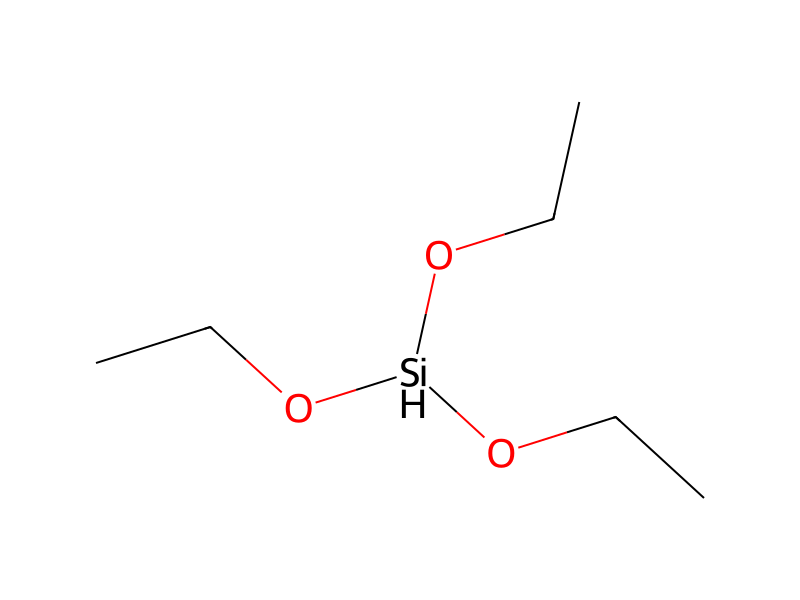
[CH2:1]=[CH:2][C:3]1[CH:8]=[CH:7][CH:6]=[CH:5][CH:4]=1.[CH2:9]([O:11][SiH:12]([O:16][CH2:17][CH3:18])[O:13][CH2:14][CH3:15])[CH3:10].P(OCC(CC)CCCC)(OCC(CC)CCCC)(O)=O>[Pt].C1(C)C=CC=CC=1>[CH2:1]([Si:12]([O:16][CH2:17][CH3:18])([O:13][CH2:14][CH3:15])[O:11][CH2:9][CH3:10])[CH2:2][C:3]1[CH:8]=[CH:7][CH:6]=[CH:5][CH:4]=1Participants
Reactant 3


Product 1

Reagents, catalysts & solvents 2


Procedure
Reaction between styrene and triethoxysilane with platinum catalyst in the presence of bis(2-ethylhexyl) hydrogenphosphate (C4H9CH(C2H5)CH2O)2P(═O)OH). 0.334 g Styrene and 0.540 g triethoxysilane were introduced into a glass tube, and 3 mg of bis(2-ethylhexyl) hydrogenphosphate were added using a microsyringe. 0.8 mg Of a toluene solution of a 0-valent platinum complex of divinylsiloxane (0.4 wt % platinum content) was added. The tube was sealed with Teflon tape and a septum and placed in a 100° C. oil bath where it was heated for 1 hour. After cooling, the tube contents were analyzed by gas chromatography revealing a styrene conversion of about 29% and a phenethyl triethoxysilane yield of 16%. The ratio between the phenethyl triethoxysilane and the (α-methylbenzyl)triethoxysilane was 5.8:1.
Workup
- customplaced in a 100° C.
- temperaturewas heated for 1 hour
- temperatureAfter cooling
Sources & evidence
- ORD record
- ord-901c918db07249078edd4c167662d892
- Source dataset
- uspto-grants-2001_12
- Patent number
- US06326506B1
Reaction notes
Loading…