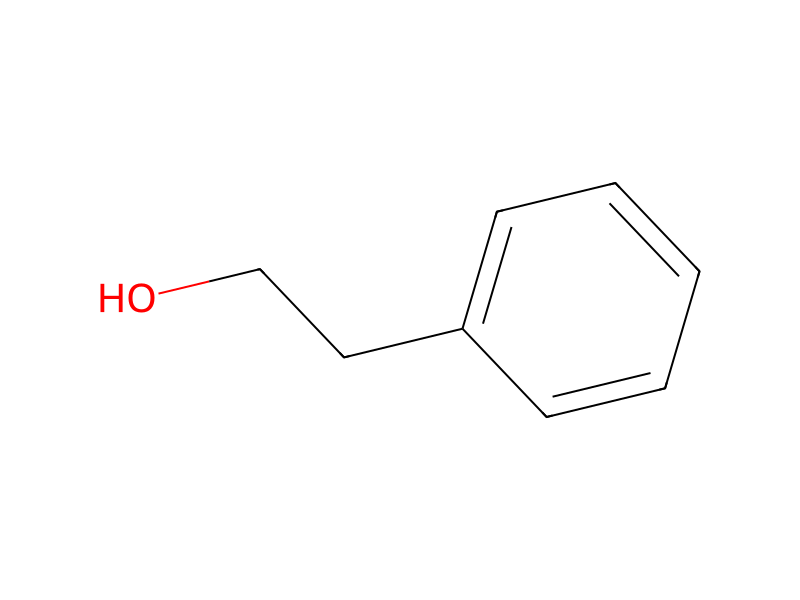
2-Phenylethanol → 3-Acetyl-5-chloro-1-phenethylindole
Reaction equation

[C:1]([C:4]1[C:12]2[C:7](=[CH:8][CH:9]=[C:10]([Cl:13])[CH:11]=2)[NH:6][CH:5]=1)(=[O:3])[CH3:2].C1(P(C2C=CC=CC=2)C2C=CC=CC=2)C=CC=CC=1.[CH2:33](O)[CH2:34][C:35]1[CH:40]=[CH:39][CH:38]=[CH:37][CH:36]=1.N(C(OC(C)C)=O)=NC(OC(C)C)=O>C1COCC1>[C:1]([C:4]1[C:12]2[C:7](=[CH:8][CH:9]=[C:10]([Cl:13])[CH:11]=2)[N:6]([CH2:33][CH2:34][C:35]2[CH:40]=[CH:39][CH:38]=[CH:37][CH:36]=2)[CH:5]=1)(=[O:3])[CH3:2]Participants
6





Procedure
To a mixture of 0.58 g (3 mmol) of 3-acetyl-5-chloroindole, 1.42 g (5.4 mmol) of triphenylphosphine and 0.66 g (5.4 mmol) of phenethyl alcohol in THF (12 ml) was added under ice-cooling, 1.09 g (5.4 mmol) of diisopropyl azodicarboxylate. After stirring for 3 hours at room temperature, the mixture was concentrated under reduced pressure. The obtained residue was chromatographed on silica gel (1/4 ethyl acetate/toluene as eluant) to give 0.58 g of the titled compound as an oil. Yield: 65%.
Workup
- additionwas added under ice-
- temperaturecooling
- concentrationthe mixture was concentrated under reduced pressure
- customThe obtained residue was chromatographed on silica gel (1/4 ethyl acetate/toluene as eluant)
Sources & evidence
- ORD record
- ord-c0e267bbb3c347e38d37dac1d733be82
- Source dataset
- uspto-grants-2001_12
- Patent number
- US06333323B1
Reaction notes
Loading…