Cyclohexylphosphine → 4-Cyclopropyl-2-nitroaniline
Reaction equation

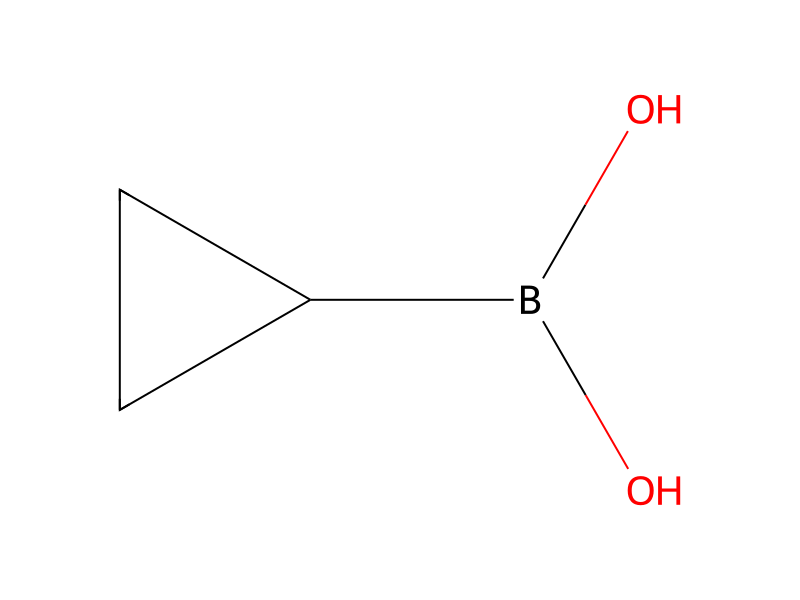
Br[C:2]1[CH:8]=[CH:7][C:5]([NH2:6])=[C:4]([N+:9]([O-:11])=[O:10])[CH:3]=1.[CH:12]1(B(O)O)[CH2:14][CH2:13]1.P([O-])([O-])([O-])=O.[K+].[K+].[K+].C1(P)CCCCC1>C1(C)C=CC=CC=1.C([O-])(=O)C.[Pd+2].C([O-])(=O)C.O>[CH:12]1([C:2]2[CH:8]=[CH:7][C:5]([NH2:6])=[C:4]([N+:9]([O-:11])=[O:10])[CH:3]=2)[CH2:14][CH2:13]1Participants
Reactant 4



Product 1

Reagents, catalysts & solvents 3



Procedure
4-Bromo-2-nitroaniline (2.17 g, 10 mmol), cyclopropylboronic acid (1.12 g, 1.30 mmol), potassium phosphate (7.42 g, 35 mmol), palladium (II) acetate (120 mg, 0.5 mmol), and cyclohexylphosphine (280 mg, 1 mmol) were combined in toluene (40 mL) and water (2 mL) and heated on an oil bath at 100° C. for 16 hours. The mixture was cooled, and the mixture was triturated with dichloromethane and water. The resulting mixture was filtered through a pad of celite. The organic layer of the filtrate was separated and dried over anhydrous sodium sulfate. Concentration gave an oil that was chromatographed over silica gel (30% v/v diethyl ether in hexanes). The faster moving compound was collected and the solvent was concentrated to give an orange oil. The oil was dissolved in hot hexanes/ethyl acetate and cooling gave 4-cyclopropyl-2-nitroaniline as orange needles (333 mg, 1.87 mmol, 19% ).
Workup
- temperatureThe mixture was cooled
- customthe mixture was triturated with dichloromethane and water
- filtrationThe resulting mixture was filtered through a pad of celite
- customThe organic layer of the filtrate was separated
- dry with materialdried over anhydrous sodium sulfate
- concentrationConcentration
- customgave an oil that
- customwas chromatographed over silica gel (30% v/v diethyl ether in hexanes)
- customwas collected
- concentrationthe solvent was concentrated
- customto give an orange oil
- temperaturecooling
Sources & evidence
- ORD record
- ord-ca64e5dc8b5e48688f4342d841cf1ff1
- Source dataset
- uspto-grants-2009_07
- Patent number
- US07557221B2
Reaction notes
Loading…