Imatinib → L-Tyrosine
反応式

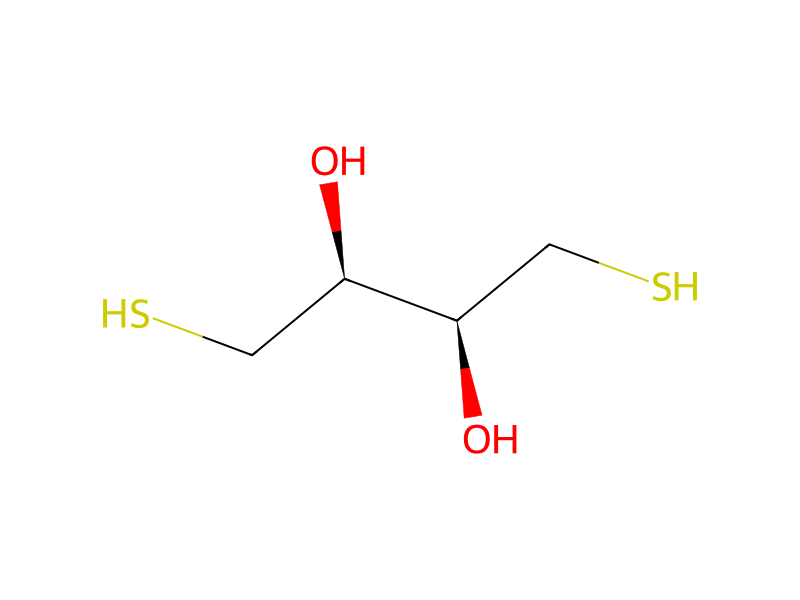
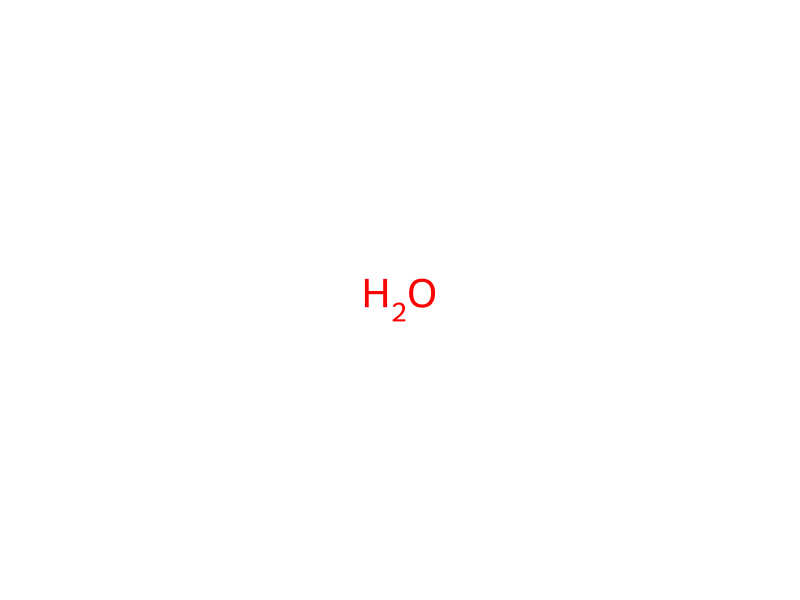
C(O)C(N)(CO)CO.[NH2:9][C@@H:10]([CH2:14][CH2:15][C:16](N[C@H](C(NCC(O)=O)=O)CS)=O)[C:11]([OH:13])=[O:12].C(O)C(N)(CO)CO.Cl.[Mg+2].[Cl-].[Cl-].[CH2:41](S)[C@@H:42](O)[C@H:43]([OH:46])[CH2:44]S.P(OC[C@H]1O[C@@H](N2C3N=CN=C(N)C=3N=C2)[C@H](O)[C@@H]1O)(OP(OP(O)(O)=O)(O)=O)(=O)O.CC1C=CC(NC(C2C=CC(CN3CCN(C)CC3)=CC=2)=O)=CC=1NC1N=CC=C(C2C=CC=NC=2)N=1>O>[NH2:9][C@H:10]([C:11]([OH:13])=[O:12])[CH2:14][C:15]1[CH:16]=[CH:44][C:43]([OH:46])=[CH:42][CH:41]=1参加物




実験手順
Bead-Based Kinase Assays. SwellGel Discs (Pierce) were suspended in cold 50 mM Tris, pH 7.5 so that 1 μl of bead suspension bound 1 μg of GST fusion protein. One nmol of GST-Crkl substrate was incubated with the glutathione bead suspension for 1 h at 4° C. with constant rotation. The substrate-bound beads were washed twice with ice-cold 50 mM Tris-HCl, pH 7.5 containing 10 mM MgCl2. Substrate-bound beads were then incubated with either recombinant v-Abl or K562 cell lysate. The v-Abl reaction mixtures contained: 20 μl 4×buffer (200 mM Tris-HCl, 40 mM MgCl2, 4 mM DTT, pH 7.5); 20 μl 40 μM ATP; 0.5 μl v-Abl (EMD Biosciences, Inc., San Diego, Calif.); 0 or 20 μl 400 μM imatinib; and water to a total volume of 80 μl. The K562 cell lysate reaction mixtures contained: 20 μl 4×buffer; 20 μl 40 μM ATP; 50 μg K562 cell lysate; 0 or 20 μl 400 μM imatinib; and water to a total volume of 80 μl. The reactions allowed to proceed for 1 h at 30° C. Following the reaction, the beads were washed twice with ice-cold 50 mM Tris, pH7.5. GST-Crkl substrates were eluted with 10 mM reduced glutathione in 50 mM Tris-HCl, pH 8.0. Kinase assay samples were loaded in a 12% SDS-PAGE gel and transferred to nitrocellulose membranes according to standard procedures. Consistent sample loading was verified using the Memcode Reversible Protein Stain Kit (Pierce). Membranes were probed with anti-phosphotyrosine antibodies.
後処理
- customfor 1 h
- customat 4° C.
- washThe substrate-bound beads were washed twice with ice-cold 50 mM Tris-HCl, pH 7.5
- additioncontaining 10 mM MgCl2
- customThe v-Abl reaction
- customThe K562 cell lysate reaction
- customthe reaction
- washthe beads were washed twice with ice-cold 50 mM Tris, pH7.5
- washGST-Crkl substrates were eluted with 10 mM reduced glutathione in 50 mM Tris-HCl, pH 8.0
出典と根拠
- ORDレコード
- ord-ddf4f89696d34b22a66dd137880611ee
- 出典データセット
- uspto-grants-2009_07
- 特許番号
- US07560258B2
反応ノート
読み込み中…