Diisopropylethylamine → 4-bromo-N-(4-isopropyl-3-methylphenyl)picolinamide
Reaction equation

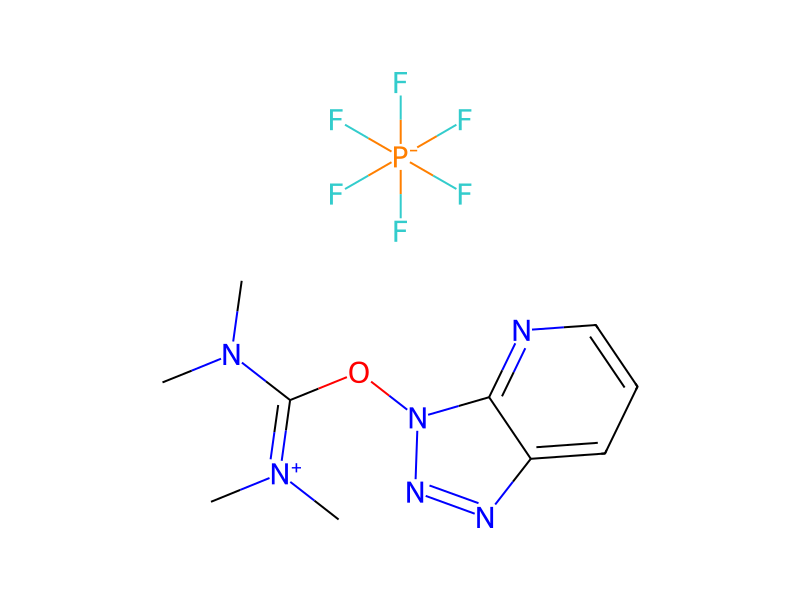
[Br:1][C:2]1[CH:7]=[CH:6][N:5]=[C:4]([C:8]([O:10]C)=O)[CH:3]=1.Cl.[CH:13]([C:16]1[CH:21]=[CH:20][C:19]([NH2:22])=[CH:18][C:17]=1[CH3:23])([CH3:15])[CH3:14].CN(C(ON1N=NC2C=CC=NC1=2)=[N+](C)C)C.F[P-](F)(F)(F)(F)F.CCN(C(C)C)C(C)C>C(Cl)Cl.CN(C=O)C>[Br:1][C:2]1[CH:7]=[CH:6][N:5]=[C:4]([C:8]([NH:22][C:19]2[CH:20]=[CH:21][C:16]([CH:13]([CH3:14])[CH3:15])=[C:17]([CH3:23])[CH:18]=2)=[O:10])[CH:3]=1Participants
7
Reactant 4



Product 1

Reagents, catalysts & solvents 2


Procedure
To a solution of methyl 4-bromopicolinate (1.0 g, 5.0 mmol) in DCM (500 mL) and DMF (20 mL) was added 4-isopropyl-3-methylbenzenamine hydrochloride (1.08 g, 5.90 mmol), HATU (3.8 g, 10 mmol), DIPEA (4.9 mL, 30 mmol) and the mixture was stirred at reflux overnight. After cooling to room temperature and evaporation of the solvent, the residue was purified by combi-flash (ISCO, 40g silica, UV254, 3:1 pet ether/ethyl acetate) to afford 4-bromo-N-(4-isopropyl-3-methylphenyl)picolinamide (1.32 g, 80% yield) as a yellow oil: MS (ES) m/z 333 (M+H).
Workup
- temperatureat reflux overnight
- customevaporation of the solvent
- customthe residue was purified by combi-flash (ISCO, 40g silica, UV254, 3:1 pet ether/ethyl acetate)
Sources & evidence
- ORD record
- ord-f777dd1fb7934bd5871f4b96b378eeb3
- Source dataset
- uspto-grants-2015_09
- Patent number
- US09145393B2
Reaction notes
Loading…