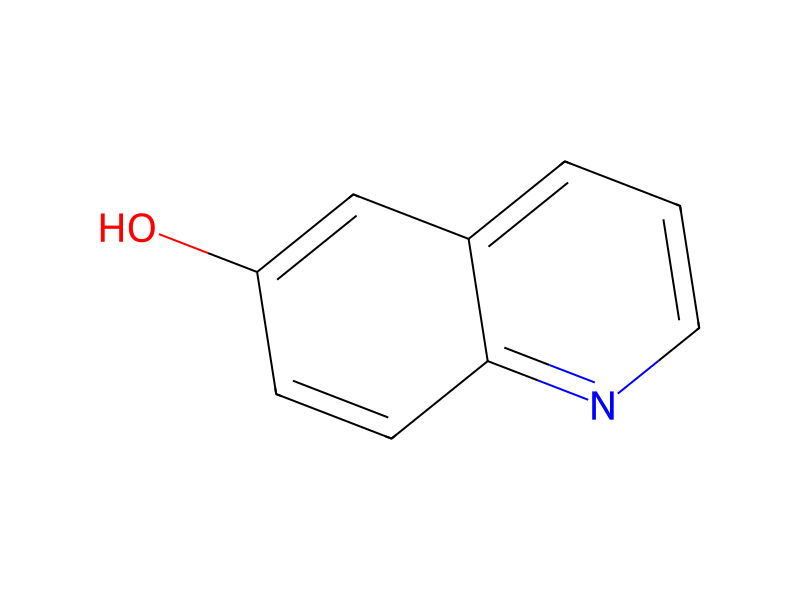
2,3-Dichloro-5,6-dicyano-1,4-benzoquinone → 6-Hydroxyquinoline
Reaction equation

FC(F)(F)S([O-])(=O)=O.C([Sn](CCCC)(CCCC)[C:14]1[CH:19]=[CH:18][CH:17]=[CH:16][N:15]=1)CCC.N1C=CC=C(B(O)O)C=1.ClC1C(=O)[C:40](C#N)=[C:41](C#N)[C:42](=[O:45])[C:43]=1Cl.N1C2C(=CC=CC=2)C=CC=1>>[OH:45][C:42]1[CH:43]=[C:19]2[C:14](=[CH:40][CH:41]=1)[N:15]=[CH:16][CH:17]=[CH:18]2Participants




Procedure
A trifluoromethanesulfonate derivative may be produced by reacting a 7-benzyloxy-4-chloroquinoline derivative with a suitable reducing agent, for example, hydrogen gas/palladium hydroxide to give an alcohol (step (i) above) and then reacting the alcohol with trifluoromethanesulfonic anhydride (step (ii) above) to give a trifluoromethanesulfonate derivative. A quinoline derivative may be produced by reacting the trifluoromethanesulfonate derivative with an alkyltin reagent, for example, tri-n-butyl-(2-pyridyl)-tin or an alkylboronic acid reagent, for example, 3-pyridylboronic acid in the presence of a suitable transition metal catalyst, for example, tetrakis triphenylphosphine palladium (step (iii) above) and reacting the resultant compound with a suitable oxidizing agent, for example, 2,3-dichloro-5,6-dicyano-1,4-benzoquinone, to give a quinoline derivative (step (iv) above). Next, a 6-hydroxyquinoline derivative may be produced by reacting the quinoline derivative with a suitable reagent, for example, boron tribromide (step (v) above). The contemplated compound may be produced by reacting the 6-hydroxyquinoline derivative with a 4-chloroquinoline derivative or a corresponding quinazolone derivative in a suitable solvent, for example, o-dichlorobenzene, or in the absence of a solvent, for example, at 120 to 180° C. (step (vi) above).
Sources & evidence
- ORD record
- ord-7e8040d146ac41f99acfb125bc61ae6d
- Source dataset
- uspto-grants-2009_07
- Patent number
- US07560558B2
Reaction notes
Loading…