Hydrochloric Acid → HCID 86709690, compound
Reaction equation

ClC(Cl)(Cl)C[O:4][C:5]([C@@H:7]1[CH2:12][CH2:11][CH2:10][N:9]([C:13](=[O:52])[C@@H:14]([NH:16][C:17](=[O:51])[C@@H:18]([NH:22][C:23](=[O:50])[C@:24]([C:41](C)(C)[O:42][SiH2]C(C)(C)C)([CH3:40])/[CH:25]=[CH:26]/[C:27]2[CH:36]=[C:35]3[C:30]([CH:31]=[CH:32][C:33]([C@H:37]([OH:39])[CH3:38])=[CH:34]3)=[CH:29][CH:28]=2)[CH:19]([CH3:21])[CH3:20])[CH3:15])[NH:8]1)=[O:6].O.[OH-].[Li+].Cl>O1CCCC1.O>[OH:39][C@@H:37]([C:33]1[CH:34]=[C:35]2[C:30]([CH:29]=[CH:28][C:27](/[CH:26]=[CH:25]/[C@@:24]([CH2:41][OH:42])([CH3:40])[C:23]([NH:22][C@@H:18]([CH:19]([CH3:20])[CH3:21])[C:17]([NH:16][C@@H:14]([CH3:15])[C:13]([N:9]3[CH2:10][CH2:11][CH2:12][C@@H:7]([C:5]([OH:6])=[O:4])[NH:8]3)=[O:52])=[O:51])=[O:50])=[CH:36]2)=[CH:31][CH:32]=1)[CH3:38]Participants
Reactant 3



Product 1

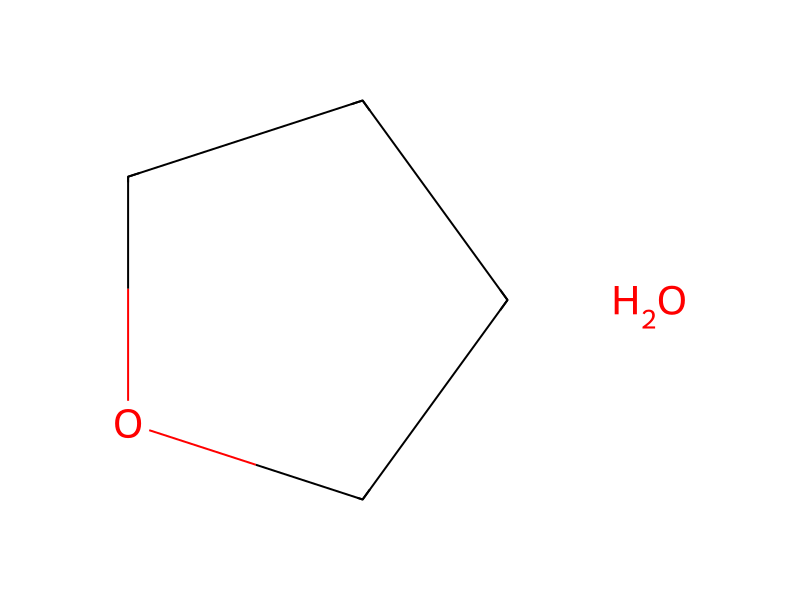
Reagents, catalysts & solvents 1
Conditions
- Temperature
- 0 °C
Procedure
A cooled (0° C.) solution of (S)-1-[(S)-2-((S)-2-{(E)-(R)-2-(tert-Butyl-dimethyl-silanyloxymethyl)-4-[2-((R)-1-hydroxy-ethyl)-naphthalen-7-yl]-2-methyl-but-3-enoylamino}-3-methyl-butyrylamino)-propionyl]-hexahydro-pyridazine-3-carboxylic acid 2,2,2-trichloro-ethyl ester (48.0 mg, 0.058 mmol) in tetrahydrofuran/water (6 mL, 5:1) was treated with lithium hydroxide monohydrate (31.2 mg, 0.743 mmol). After stirring at 0° C. for 1.6 h, the reaction was quenched with hydrochloric acid (2 M, 380 μL, 0.743 mmol). The volatiles were removed in vacuo and the residual acetic acid and trichloroethanol were azeotroped off with toluene/tetrahydrofuran (6×). The solid was then triturated with diethyl ether to provide (S)-1-[(S)-2-((S)-2-{(E)-(R)-4-[7-((R)-1-hydroxy-ethyl)-naphthalen-2-yl]-2-hydroxymethyl-2-methyl-but-3-enoylamino}-3-methyl-butyrylamino)-propionyl]-hexahydro-pyridazine-3-carboxylic acid as a white solid. LCMS (m/z) 583.3 [M+H], Tr=1.97 min. In a 3-neck 100 mL round bottom flask was introduced 4 Å molecular sieves, 2-methyl-6-nitrobenzoic anhydride (50 mg, 0.145 mmol), N,N-dimethylaminopyridine (53.1 mg, 0.435 mmol) and 1,2-dichloroethane (20 mL). The mixture was maintained at 50° C. while a solution of (S)-1-[(S)-2-((S)-2-{(E)-(R)-4-[7-((R)-1-hydroxy-ethyl)-naphthalen-2-yl]-2-hydroxymethyl-2-methyl-but-3-enoylamino}-3-methyl-butyrylamino)-propionyl]-hexahydro-pyridazine-3-carboxylic acid in N,N-dimethylformamide (1.5 mL) was added via syringe pump over 2 h. The flask was rinsed with N,N-dimethylformamide (1.5 mL) which was then added at the same rate to the reaction mixture. After stirring at 50° C. for 2 h, 2-methyl-6-nitrobenzoic anhydride (50 mg, 0.145 mmol) and N,N-dimethylaminopyridine (53.1 mg, 0.435 mmol) were added. After stirring at 50° C. for 1 h, the heating was stopped and the reaction was allowed to stand at room temperature overnight. The volatiles were removed in vacuo and the residual N,N-dimethylformamide was azeotroped off with toluene. The residue was partitioned between ethyl acetate and hydrochloric acid (1 M). The organics were then washed with a saturated solution of sodium bicarbonate, dried over anhydrous sodium sulfate, filtered and the volatiles were removed in vacuo. The residue was first purified by silica gel chromatography using a 10 g Isolute cartridge eluted with ethyl acetate then by reverse phase preparative HPLC to provide compound 104 (2.9 mg, 8.8%) as a white solid and compound 105 (3.7 mg) as a white solid.
Workup
- customThe volatiles were removed in vacuo
- customthe residual acetic acid and trichloroethanol were azeotroped off with toluene/tetrahydrofuran (6×)
- customThe solid was then triturated with diethyl ether
Sources & evidence
- ORD record
- ord-ebe9928fc40d4cfcb13ee7e7945411f4
- Source dataset
- uspto-grants-2015_09
- Patent number
- US09145441B2
Reaction notes
Loading…