Hydrochloric Acid → 3-Chloro-4-(2,3-dichlorophenyl)-1H-pyrrole
Reaction equation

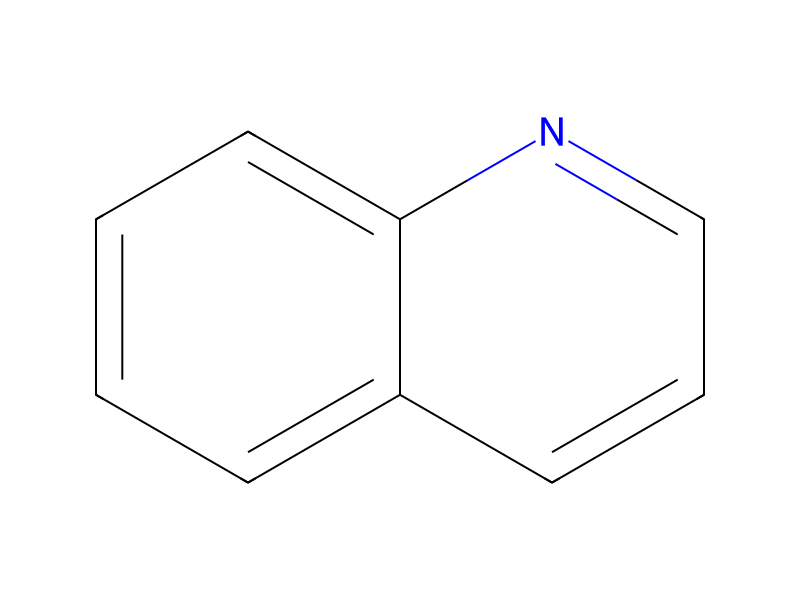
[Cl:1][C:2]1[C:3]([C:13]2[CH:18]=[CH:17][CH:16]=[C:15]([Cl:19])[C:14]=2[Cl:20])=[C:4](C(O)=O)[NH:5][C:6]=1C(O)=O.N1C2C(=CC=CC=2)C=CC=1.Cl>C(OCC)(=O)C>[Cl:1][C:2]1[C:3]([C:13]2[CH:18]=[CH:17][CH:16]=[C:15]([Cl:19])[C:14]=2[Cl:20])=[CH:4][NH:5][CH:6]=1Participants
Reactant 3


Product 1

Reagents, catalysts & solvents 1

Procedure
The mixture of 53 g of 4-chloro-3-(2,3-dichlorophenyl)pyrol-2,5-dicarboxylic acid, 2.65 g of cupric acid and 80 ml of quinoline was heated at 140°-150° C. for 30 minutes with stirring. To the resulting reaction mixture were added ethyl acetate, ice and concentrated hydrochloric acid which of molar amount was 1.1-time that of employed quinoline. The ethyl acetate layer was washed with successive, water, aqueous sodium carbonate and water. After dehydration, the ethyl acetate layer was evaporated to dryness under reduced pressure to obtain 33.1 g of brown product. The crude product was purified by silicagel chromatography and countercurrent distribution to obtain pale yellow oily substance. The oily substance was recrystallized from n-hexane to obtain 22.5 g of the desired product (colorless or pale yellow needles, m.p. 58°-59° C.).
Workup
- temperaturewas heated at 140°-150° C. for 30 minutes
- customTo the resulting reaction mixture
- washThe ethyl acetate layer was washed with successive, water, aqueous sodium carbonate and water
- customAfter dehydration, the ethyl acetate layer was evaporated to dryness under reduced pressure
Sources & evidence
- ORD record
- ord-8f8ab44583774f2094fe7505da4d4542
- Source dataset
- uspto-grants-1982_04
- Patent number
- US04326881
Reaction notes
Loading…