Imidazole → HCID 54284754, compound
Reaction equation

[OH:1][C:2]1[CH:3]=[C:4]([CH:8]=[CH:9][CH:10]=1)[C:5]([OH:7])=[O:6].N1C=CN=C1.[C:16]1([Si:22](Cl)([C:27]2[CH:32]=[CH:31][CH:30]=[CH:29][CH:28]=2)[C:23]([CH3:26])([CH3:25])[CH3:24])[CH:21]=[CH:20][CH:19]=[CH:18][CH:17]=1>CN(C)C=O>[OH:1][C:2]1[CH:3]=[C:4]([CH:8]=[CH:9][CH:10]=1)[C:5]([O:7][Si:22]([C:16]1[CH:21]=[CH:20][CH:19]=[CH:18][CH:17]=1)([C:27]1[CH:28]=[CH:29][CH:30]=[CH:31][CH:32]=1)[C:23]([CH3:26])([CH3:24])[CH3:25])=[O:6]Participants
5
Reactant 3


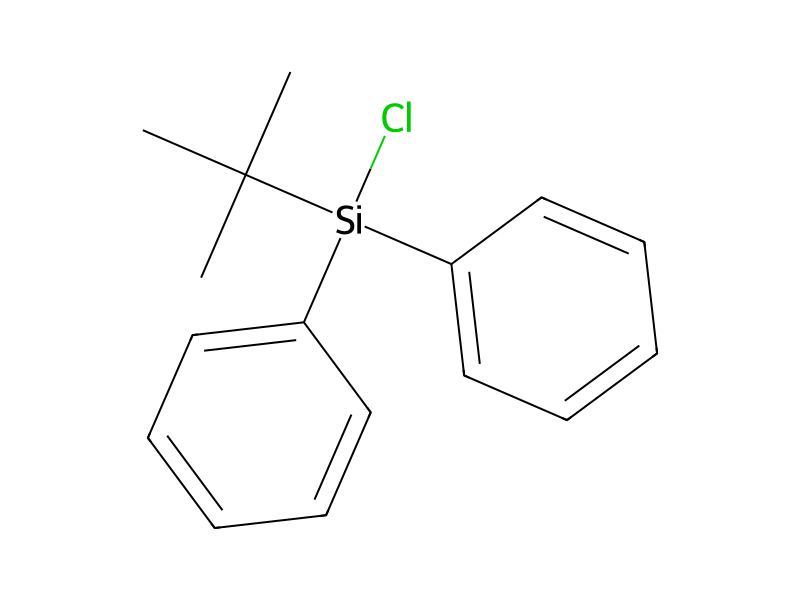
Product 1

Reagents, catalysts & solvents 1

Procedure
To stirred solution of 50.4 g of 3-hydroxybenzoic acid in 200 ml of dry dimethylformamide at 0° C. was added 24.85 g of imidazole, followed by 100 g of diphenyl-(2-methylprop-2-yl)silyl chloride. The mixture was stirred at room temperature for 16 hours, and partitioned between ethyl acetate and cold water. The organic layer was washed with water, with an aqueous potassium hydrogen carbonate solution and with brine, was dried over anhydrous magnesium sulphate and evaporated to dryness. The resulting white solid was slurried in dry chloroform and filtered to afford 72 g of the title compound.
Workup
- custompartitioned between ethyl acetate and cold water
- washThe organic layer was washed with water, with an aqueous potassium hydrogen carbonate solution and with brine
- dry with materialwas dried over anhydrous magnesium sulphate
- customevaporated to dryness
- filtrationfiltered
Sources & evidence
- ORD record
- ord-9e8ffa4e6b3c4722a96061e80dbc1af1
- Source dataset
- uspto-grants-1989_01
- Patent number
- US04795748
Reaction notes
Loading…