Formaldehyde → 2-{[Bis(2-hydroxyethyl)amino]methyl}-4,6-dibromophenol
Reaction equation

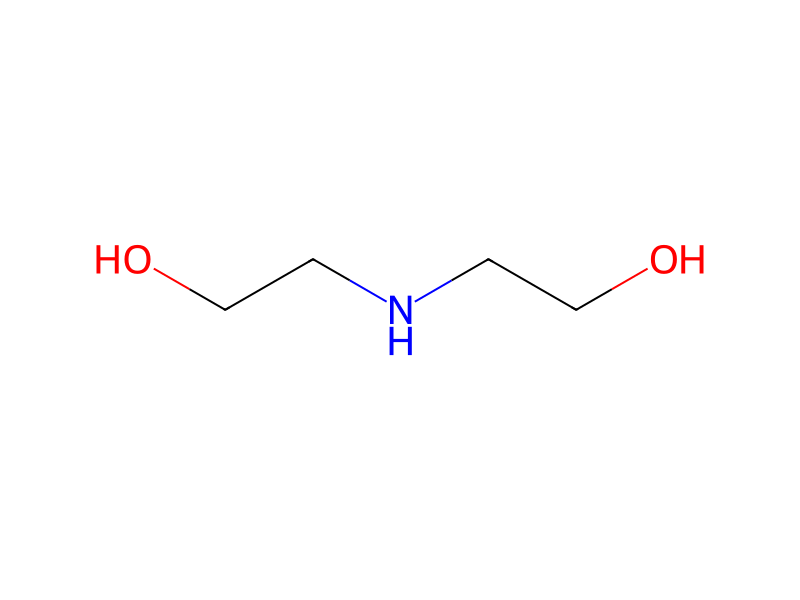
[Br:1][C:2]1[CH:7]=[C:6]([Br:8])[CH:5]=[CH:4][C:3]=1[OH:9].[NH:10]([CH2:14][CH2:15][OH:16])[CH2:11][CH2:12][OH:13].[CH2:17]=O>>[Br:1][C:2]1[CH:7]=[C:6]([Br:8])[CH:5]=[C:4]([CH2:17][N:10]([CH2:14][CH2:15][OH:16])[CH2:11][CH2:12][OH:13])[C:3]=1[OH:9]Participants
4



Procedure
252 g of 2,4-dibromophenol and 105 g of diethanolamine were charged to a 1 liter round-bottomed flask fitted with an agitator. The temperature of the clear viscous liquid was adjusted to 40 Deg. C. and 100 g of formalin (30% formaldehyde in water stabilised with methanol) was added dropwise over 1 hour while maintaining the temperature at 40-45 Deg C. The temperature was then raised to 100-110 Deg. C. and maintained at that temperature for 4 hours. Vacuum was then applied to distil off excess formaldehyde, methanol and water.
Workup
- customfitted with an agitator
- temperaturewhile maintaining the temperature at 40-45 Deg C
- temperatureThe temperature was then raised to 100-110 Deg
- temperatureand maintained at that temperature for 4 hours
- customto distil off excess formaldehyde, methanol and water
Sources & evidence
- ORD record
- ord-399ce7c6742141ddb2aad52fdedd0d4c
- Source dataset
- uspto-grants-1989_01
- Patent number
- US04797429
Reaction notes
Loading…