Trichloroacetic Acid → O-[2-(4-Chlorophenoxy)propyl]hydroxylamine
Reaction equation

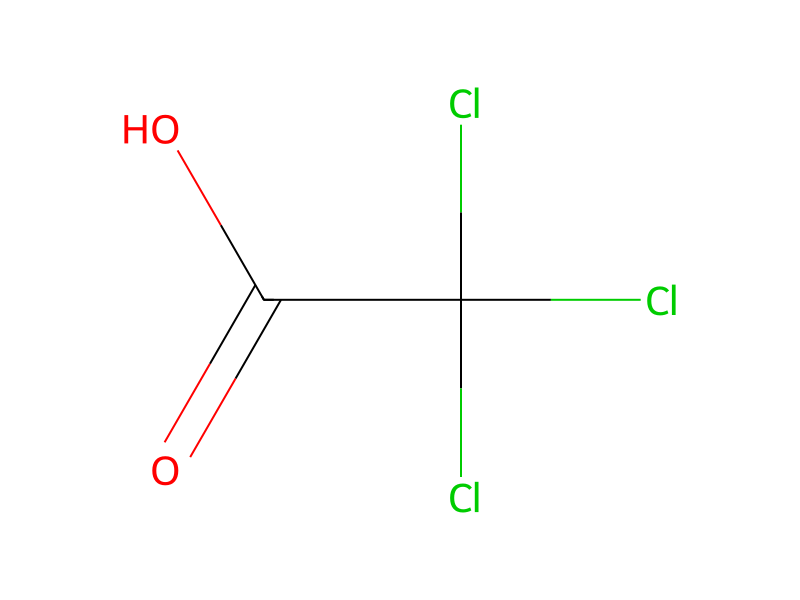
[Cl:1][C:2]1[CH:16]=[CH:15][C:5]([O:6][CH:7]([CH3:14])[CH2:8][O:9][N:10]=C(C)C)=[CH:4][CH:3]=1.ClC(Cl)(Cl)C(O)=O>O>[Cl:1][C:2]1[CH:3]=[CH:4][C:5]([O:6][CH:7]([CH3:14])[CH2:8][O:9][NH2:10])=[CH:15][CH:16]=1Participants
4
Reactant 2

Product 1

Reagents, catalysts & solvents 1

Conditions
- Temperature
- 78 °C
Procedure
A mixture of 10 g (4.13 mmol) of acetone O-[2-(4-chlorophenoxy)-propyl]-oxime (compound 28 in Table 1) and 44 g of 30% strength by weight aqueous trichloroacetic acid solution was heated for 10 hours at 78° C. and a reduced pressure of 450 mbar in a stirred apparatus having an attached 30 cm column, 110 g of water being continuously added dropwise to the reaction mixture and the resulting water/acetone mixture being continuously distilled off. The reacted mixture was worked up by rendering it alkaline with 10% strength by weight sodium hydroxide solution and extracting it with toluene. 6 g of 2-(4-chlorophenoxy)-propoxyamine were isolated. Yield: 72%.
Workup
- additioncontinuously added dropwise to the reaction mixture
- distillationthe resulting water/acetone mixture being continuously distilled off
- extractionextracting it with toluene
Sources & evidence
- ORD record
- ord-16e8331f5dc848c99063ab389a0dbb0e
- Source dataset
- uspto-grants-1997_11
- Patent number
- US05684200
Reaction notes
Loading…