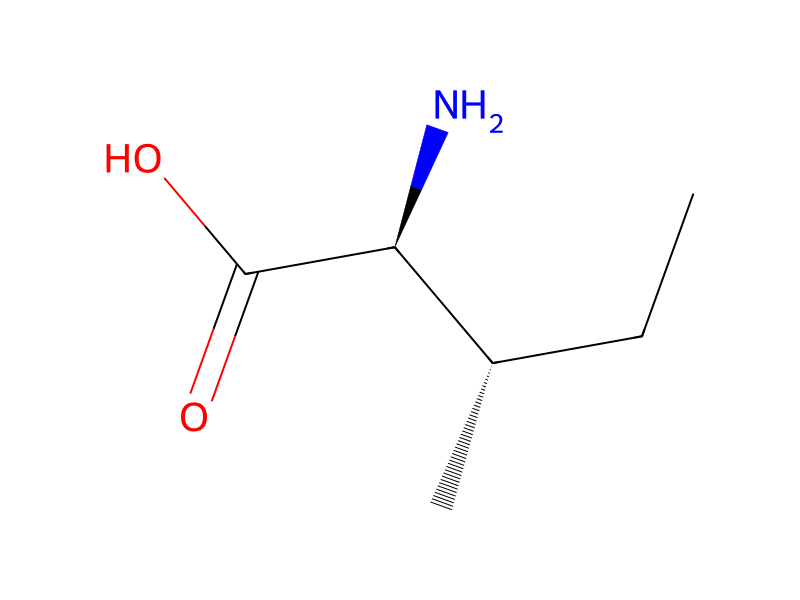
Triethylamine → L-Isoleucine
Reaction equation

[NH:1]1[CH2:8][CH2:7][CH2:6][C@H:2]1[C:3]([OH:5])=[O:4].[CH2:9](NC(=O)[C@H]([C@H](CC)C)N)C1C=CC=CC=1.C(N(CC)CC)C.ClCC(NC1C=CC(Cl)=CC=1Cl)=O>C1COCC1>[NH2:1][C@H:2]([C:3]([OH:5])=[O:4])[C@H:6]([CH2:7][CH3:8])[CH3:9]Participants
5
Reactant 3



Product 1
Reagents, catalysts & solvents 1

Procedure
Using the procedure described in Example 5, treatment of a solution of L-proline-L-isoleucine benzylamide (58 mg, 0.18 mmol), with triethylamine (130 uL, 0.93 mmol, 5.0 eq), and N-chloroacetyl-2,4-dichloroaniline (53 mg, 0.22 mmol, 1.2 eq) in THF (7 mL), provided a crude product. A portion of the product was purified by preparative TLC to provide 30 mg (32%) of L-isoleucine, N-[1-(2,4-dichlorophenylcarbamoylmethyl)-L-proline] benzylamide.
Workup
- customprovided a crude product
- customA portion of the product was purified by preparative TLC
Sources & evidence
- ORD record
- ord-84f34aa70e3642fa9ada3fcc49d18b40
- Source dataset
- uspto-grants-1997_11
- Patent number
- US05686424
Reaction notes
Loading…