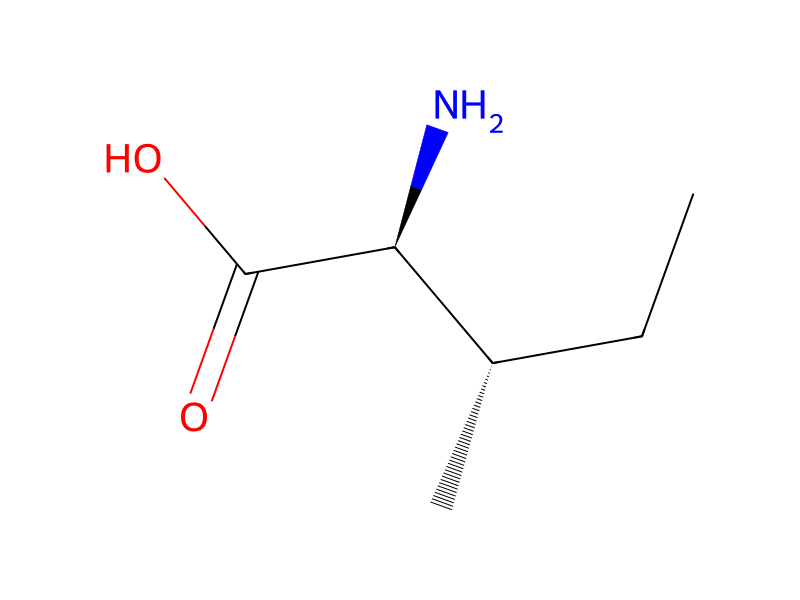
Triethylamine → L-Isoleucine
Reaction equation

[NH:1]1[CH2:8][CH2:7][CH2:6][C@H:2]1[C:3]([OH:5])=[O:4].[CH2:9](NC(=O)[C@H]([C@H](CC)C)N)C1C=CC=CC=1.C(N(CC)CC)C.ClCC(C1CCC(CCCCC)CC1)=O.C([C@H]1CC[C@H](C(O)=O)CC1)CCCC>C1COCC1>[NH2:1][C@H:2]([C:3]([OH:5])=[O:4])[C@H:6]([CH2:7][CH3:8])[CH3:9]Participants
6
Reactant 4



Product 1
Reagents, catalysts & solvents 1

Procedure
Using the procedure described in Example 5, a solution of L-proline-L-isoleucine benzylamide (160 mg, 0.50 mmol), and triethylamine (352 uL, 2.53 mmol, 5.0 eq), in THF (2 mL), was treated with 232 mg (1.0 mmol) of 1-chloro-2-(4-pentylcyclohexyl)-2-oxoethane (prepared from trans-4-pentylcyclohexanecarboxylic acid using the procedure described in example 1) to provide 154 mg, (25%) of L-isoleucine, N-[1-(2-(4-pentylycyclohexyl)-2-oxoethyl)-L-prolyl] benzylamide.
Sources & evidence
- ORD record
- ord-418d8366bb2f48cda371486bea62d194
- Source dataset
- uspto-grants-1997_11
- Patent number
- US05686424
Reaction notes
Loading…