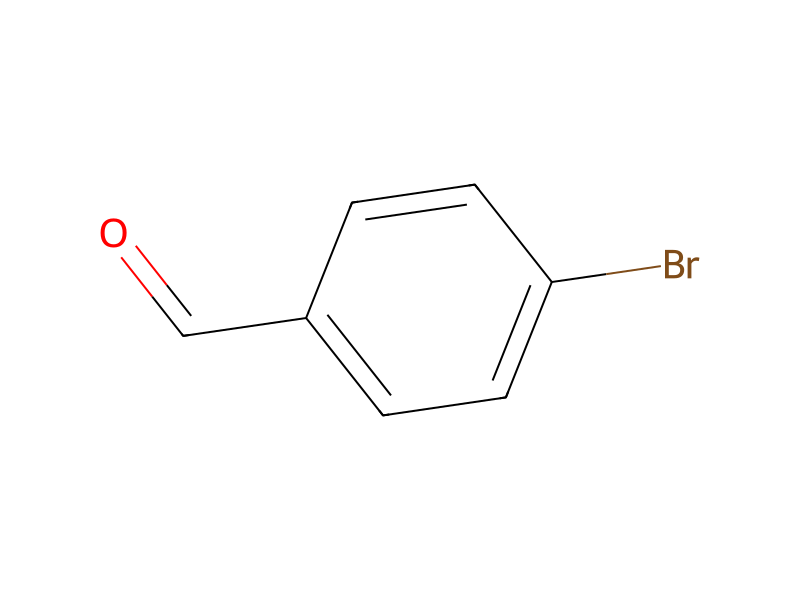
4-Bromobenzaldehyde → 1-(4-Bromophenyl)-2-methylpropan-1-ol
Reaction equation

[Br:1][C:2]1[CH:9]=[CH:8][C:5]([CH:6]=[O:7])=[CH:4][CH:3]=1.[CH:10]([Mg]Br)([CH3:12])[CH3:11]>O1CCCC1>[Br:1][C:2]1[CH:9]=[CH:8][C:5]([CH:6]([OH:7])[CH:10]([CH3:12])[CH3:11])=[CH:4][CH:3]=1Participants
4
Reactant 2

Product 1

Reagents, catalysts & solvents 1

Conditions
- Temperature
- 0 °C
Procedure
To a flame-dried flask under an argon atmosphere is added 1.85 g of commercially available 4-bromobenzaldehyde and charged with 30 mL of tetrahydrofuran. The solution is cooled to 0 ° C. and slowly treated with 7.0 mL of isopropylmagnesium bromide. After stirring overnight at room temperature the reaction mixture is concentrated under reduced pressure. The residue is partioned between diethyl ether and saturated ammonium chloride; the aqueous layer is then extracted with diethyl ether. The combined organic phases are dried (magnesium sulfate), and the volatiles are removed. The residue is flash column chromatographed using 30% to 60% diethyl ether in hexane to afford 1.25 g of the title product as a viscous, tan oil.
Workup
- concentrationis concentrated under reduced pressure
- extractionthe aqueous layer is then extracted with diethyl ether
- dry with materialThe combined organic phases are dried (magnesium sulfate)
- customthe volatiles are removed
- customchromatographed
Sources & evidence
- ORD record
- ord-065fd781e33f41478b82a05cd32cb4d7
- Source dataset
- uspto-grants-1997_11
- Patent number
- US05686486
Reaction notes
Loading…