Mexiletine → Mexiletine acetate
Reaction equation
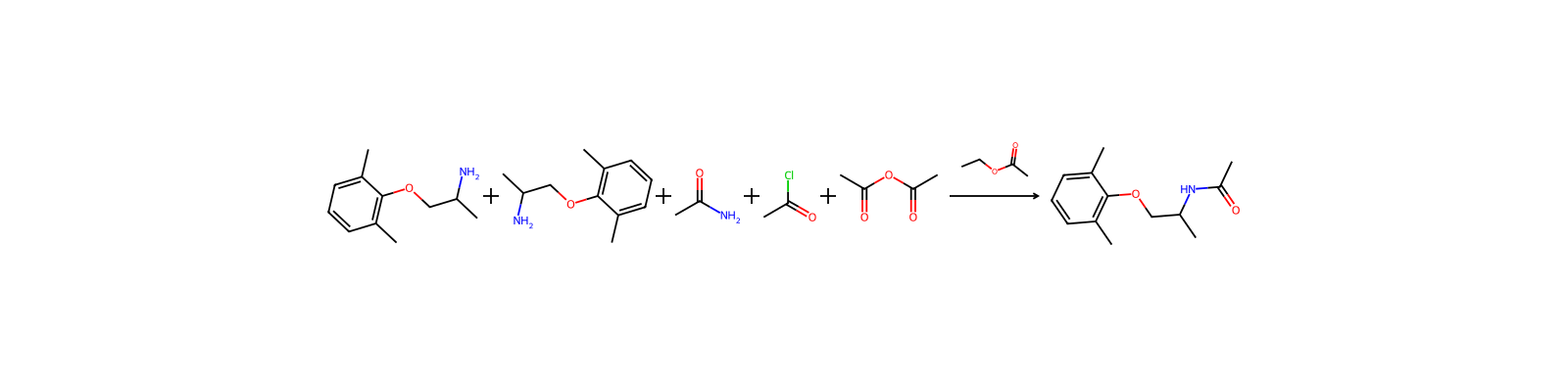
[CH3:1][C:2]1[CH:12]=[CH:11][CH:10]=[C:9]([CH3:13])[C:3]=1[O:4][CH2:5][CH:6]([NH2:8])[CH3:7].CC1[C:20]([O:21]CC(N)C)=[C:19](C)C=CC=1.C(N)(=O)C.C(Cl)(=O)C.C(OC(=O)C)(=O)C>C(OCC)(=O)C>[CH3:1][C:2]1[CH:12]=[CH:11][CH:10]=[C:9]([CH3:13])[C:3]=1[O:4][CH2:5][CH:6]([NH:8][C:20](=[O:21])[CH3:19])[CH3:7]Participants
6
Reactant 4




Product 1

Reagents, catalysts & solvents 1

Procedure
In Step 1, 2-(2,6-dimethylphenoxy)-1-methyl-ethylamine (mexiletine) is converted to mexiletine acetamide. Mexiletine is treated with an acetylating agent, such as an acetyl chloride or acetic anhydride, in the presence of concentrated aqueous alkali and an organic solvent, e.g., ethyl acetate. The reaction temperature is maintained at about 0°-25° C., preferably below 10° C., for about 10 minutes to 3 hours, preferably about 35 minutes. Following completion of the reaction, the resulting N-[2-(2,6-dimethylphenoxy)-1-methylethyl]-acetamide is isolated by conventional techniques, and used as such in Step 2.
Workup
- temperatureThe reaction temperature is maintained at about 0°-25° C., preferably below 10° C., for about 10 minutes to 3 hours, preferably about 35 minutes
- customcompletion of the reaction
Sources & evidence
- ORD record
- ord-8d671e650dfa4e4b80688111e6b099e7
- Source dataset
- uspto-grants-1997_11
- Patent number
- US05688830
Reaction notes
Loading…