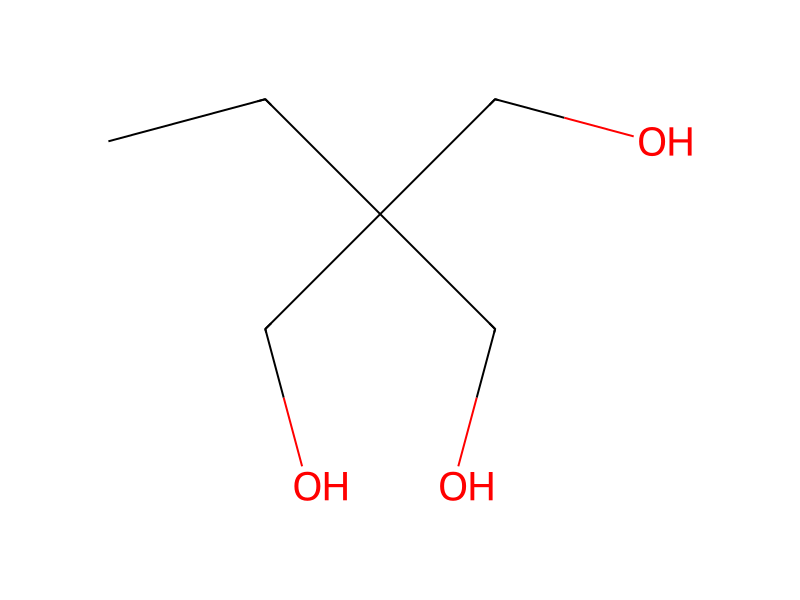
Trimethylolpropane → 1-(1-Bromoethyl)-4-ethyl-2,6,7-trioxabicyclo[2.2.2]octane
Reaction equation

[CH2:1]([O:3][C:4]([O:11][CH2:12][CH3:13])([O:8][CH2:9]C)[CH:5]([Br:7])[CH3:6])C.[CH2:14]([C:16](CO)(CO)CC)O>C1(C)C=CC(S(O)(=O)=O)=CC=1.C(O)C>[Br:7][CH:5]([C:4]12[O:3][CH2:1][C:13]([CH2:14][CH3:16])([CH2:9][O:8]1)[CH2:12][O:11]2)[CH3:6]Participants
5




Conditions
- Temperature
- 140 °C
Procedure
25.5 g (0.1 moles) of the product obtained in step (a) above, 13.4 g (0.1 moles) of trimethylolpropane and 0.05 g of p-toluenesulfonic acid were placed in a flask fitted with a Dean & Stark condenser and the contents of the flask were heated at 140° C. for about 2 hours. The reaction was stopped when a theoretical amount of ethyl alcohol was evaporated off, after which the reaction solution was distilled under reduced pressure using a Vigreaux distillation column to yield 16 g (63%) of the desired product having a boiling point of 81°-83° C./0.1 mmHg.
Workup
- customfitted with a Dean & Stark condenser
- customwas evaporated off
- distillationafter which the reaction solution was distilled under reduced pressure
- distillationa Vigreaux distillation column
Sources & evidence
- ORD record
- ord-02791f7f5d8f4b5a8e0a50cffeb017c0
- Source dataset
- uspto-grants-1984_01
- Patent number
- US04425473
Reaction notes
Loading…