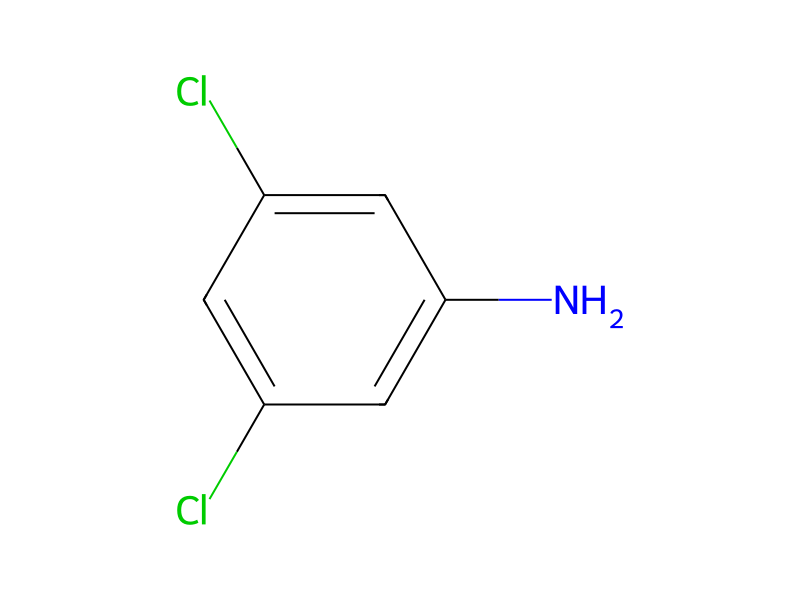
Phenol → 3,5-Dichloroaniline
Reaction equation

ClC1C(Cl)=C(C=CC=1)N(Cl)Cl.Cl[C:13]1[C:18]([NH2:19])=[C:17](Cl)[C:16]([Cl:21])=[C:15](Cl)[C:14]=1[Cl:23].C1(O)C=CC=CC=1.[I-].[Na+].[H][H]>O>[Cl:21][C:16]1[CH:17]=[C:18]([CH:13]=[C:14]([Cl:23])[CH:15]=1)[NH2:19]Participants
7
Reactant 5





Product 1
Reagents, catalysts & solvents 1

Procedure
131 parts of a mixture of tetrachloroaniline and pentachloroaniline, corresponding to the composition given in Example 3, 200 parts of phenol and 9 parts of sodium iodide are reacted in the presence of 22 parts of a ruthenium-on-charcoal catalyst (5% strength) which is moist with water and has already been used for 6 similar reaction cycles, corresponding to 15 parts of dry catalyst, with hydrogen at 165° C. under a pressure of 40 to a maximum of 50 bars, during the course of 8 hours. After the usual working up, 91.5 parts of 3,5-dichloroaniline are obtained, with complete conversion of the starting material. Yield: 98% of theory.
Sources & evidence
- ORD record
- ord-a58fcb290e2844b49e8b2a033ea07966
- Source dataset
- uspto-grants-1984_01
- Patent number
- US04429156
Reaction notes
Loading…