Sodium Carbonate → 2-(2,4-Dichlorophenyl)-6-chloro-3-nitropyridine
Reaction equation

Cl[C:2]1[C:7]([N+:8]([O-:10])=[O:9])=[CH:6][CH:5]=[C:4]([Cl:11])[N:3]=1.[Cl:12][C:13]1[CH:18]=[C:17]([Cl:19])[CH:16]=[CH:15][C:14]=1B(O)O.C([O-])([O-])=O.[Na+].[Na+]>C1COCC1>[Cl:12][C:13]1[CH:18]=[C:17]([Cl:19])[CH:16]=[CH:15][C:14]=1[C:2]1[C:7]([N+:8]([O-:10])=[O:9])=[CH:6][CH:5]=[C:4]([Cl:11])[N:3]=1Participants
5
Reactant 3

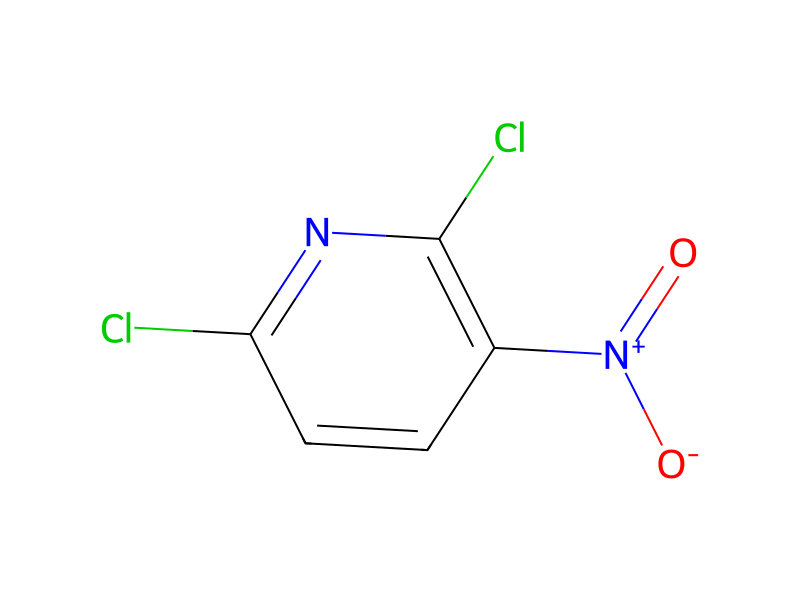

Product 1

Reagents, catalysts & solvents 1

Procedure
1 mmol 2,6-dichloro-3-nitropyridine, 1.05 mmol of 2,4-dichlorobenzeneboronic acid, and 3 mmol of Na2CO3, were dissolved in 1.5 ml THF and 0.5 ml water and purged with nitrogen. 0.05 mmol of [1,1′-Bis(diphenylphosphino)-ferrocene]dichloro-palladium(II) was added to reaction and stirred at room temperature under nitrogen for fourteen hours. The reaction mixture was concentrated in vacuo and diluted with water and ethyl acetate. The solution was extracted three times with ethyl acetate, dried over sodium sulfate, and purified by column chromatography eluting with 10% ethylacetate 90% hexanes to obtain 2-(2,4-dichlorophenyl)-6-chloro-3-nitropyridine.
Workup
- custom0.5 ml water and purged with nitrogen
- concentrationThe reaction mixture was concentrated in vacuo
- additiondiluted with water and ethyl acetate
- extractionThe solution was extracted three times with ethyl acetate
- dry with materialdried over sodium sulfate
- custompurified by column chromatography
- washeluting with 10% ethylacetate 90% hexanes
Sources & evidence
- ORD record
- ord-772e205f02de41ec9ba0ee35da92dd1a
- Source dataset
- uspto-grants-2002_12
- Patent number
- US06489344B1
Reaction notes
Loading…