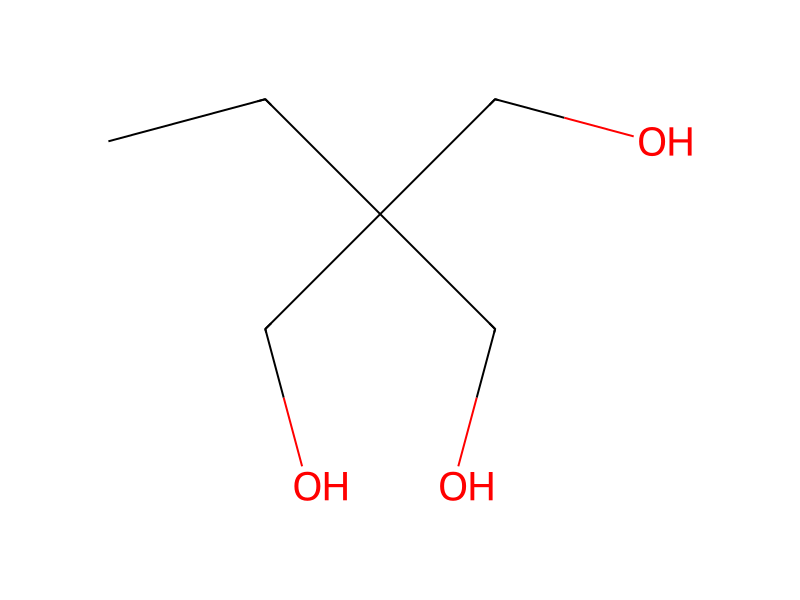
Trimethylolpropane → Bisphenol A diglycidyl ether
Reaction equation

C([C:3]([CH2:8][OH:9])([CH2:6]O)CC)O.[CH2:10]([O:14][CH2:15][CH:16]1O[CH2:17]1)[CH:11]1[O:13][CH2:12]1.OC1[CH:25]=[CH:24][C:23]([C:26]([C:29]2[CH:34]=[CH:33][C:32]([OH:35])=[CH:31][CH:30]=2)([CH3:28])[CH3:27])=CC=1>>[CH3:28][C:26]([C:23]1[CH:17]=[CH:16][C:15]([O:14][CH2:10][CH:11]2[O:13][CH2:12]2)=[CH:25][CH:24]=1)([C:29]1[CH:30]=[CH:31][C:32]([O:35][CH2:6][CH:3]2[O:9][CH2:8]2)=[CH:33][CH:34]=1)[CH3:27]Participants
4


Procedure
Trimethylolpropane (TMP) used in the epoxy hardeners is a cheap, non-toxic, low melting point crystalline solid which is incompatible with diglycidylether of bisphenol A (DGEBA). TMP is presently used as a hardener for flexible polyurethanes. Clear solutions with DGEBA may be obtained by heating the mixture above the melting point of TMP, but the mixture becomes milky on cooling to room temperature and gross phase separation occurs on standing. TMP is unreactive with epoxy absent a suitable catalyst.
Sources & evidence
- ORD record
- ord-f3587e97936d49d494c79a5db59272f3
- Source dataset
- uspto-grants-2002_12
- Patent number
- US06491845B1
Reaction notes
Loading…