Hydrogen Bromide → 2-Propanone, 1-bromo-1-phenyl-
Reaction equation

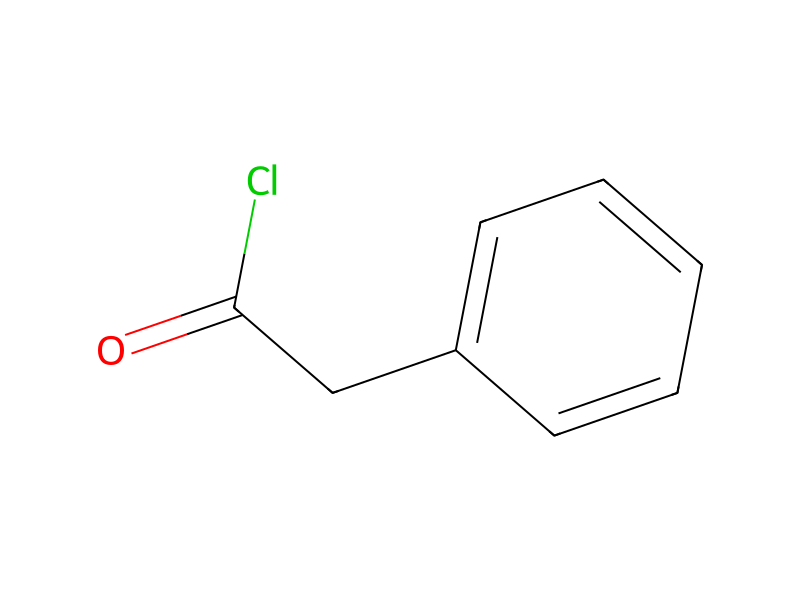
[C:1]1([CH2:7][C:8](Cl)=[O:9])[CH:6]=[CH:5][CH:4]=[CH:3][CH:2]=1.[CH3:11][Si](C=[N+]=[N-])(C)C.[BrH:18]>CC#N.CCCCCC.C(O)(=O)C>[Br:18][CH:7]([C:1]1[CH:6]=[CH:5][CH:4]=[CH:3][CH:2]=1)[C:8](=[O:9])[CH3:11]Participants
7






Procedure
To a solution of 132 μL (1.00 mmol) of phenylacetyl chloride in 1.0 mL of anhyd MeCN was added 1.05 mL (2.10 mmol) of a 2 M solution of trimethylsilyldiazomethane in hexane. After stirring 1 h at room temperature, the mixture was cooled (0° C.) and 300 μL (1.50 mmol) of 30 wt % HBr in acetic acid was added dropwise (gas evolution). After stirring 15 min, the mixture was concentrated in vacuo and rapidly chromatographed on a 2 g silica SPE column (Waters Sep-Pak) with 50% CH2Cl2-hexane to afford the title compound as a pale yellow oil (201 mg, 94%). 1H-NMR (300 MHz, CDCl3) δ7.2-7.4 (m, 5H), 3.95 (s, 2H), 3.92 (s, 2H).
Workup
- additionwas added dropwise (gas evolution)
- stirringAfter stirring 15 min
- concentrationthe mixture was concentrated in vacuo
- customrapidly chromatographed on a 2 g silica SPE column (Waters Sep-Pak) with 50% CH2Cl2-hexane
Sources & evidence
- ORD record
- ord-9e849c6cebc7428da62e5db3fd04463d
- Source dataset
- uspto-grants-2002_12
- Patent number
- US06492403B1
Reaction notes
Loading…