Water → 2-Cyano-3-nitropyridine
Reaction equation

Cl[C:2]1[C:7]([N+:8]([O-:10])=[O:9])=[CH:6][CH:5]=[CH:4][N:3]=1.[Cu](C#N)[C:12]#[N:13].O>CN(C=O)C>[C:12]([C:2]1[C:7]([N+:8]([O-:10])=[O:9])=[CH:6][CH:5]=[CH:4][N:3]=1)#[N:13]Participants
5
Reactant 3

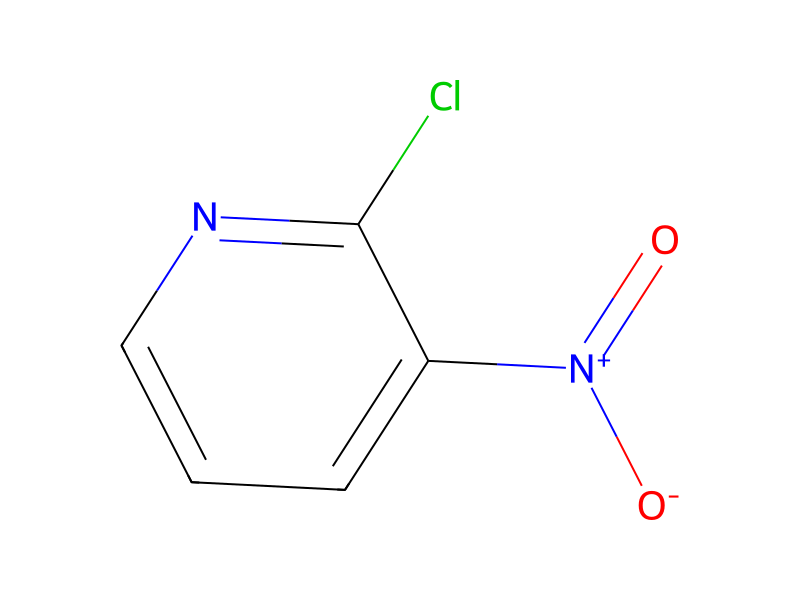

Product 1

Reagents, catalysts & solvents 1

Conditions
- Temperature
- 100 °C
Procedure
To a solution of 2-chloro-3-nitropyridine (5 g, 31.6 mmol, 1.0 eq.) in 50 mL of DMF was added copper cyanide (2.47 g, 38 mmol, 1.2 eq.) and the reaction heated to 100° C. for 16 hours. The reaction mixture was cooled to ambient temperature and poured into 100 mL of water. The mixture was extracted with ethyl acetate (3×50 mL) and the combined ethyl acetate portions were dried over sodium sulfate and concentrated. The crude material was chromatographed on silica with 3:7 ethyl acetate/hexanes to give 2-cyano-3-nitropyridine as a yellow solid.
Workup
- temperatureThe reaction mixture was cooled to ambient temperature
- extractionThe mixture was extracted with ethyl acetate (3×50 mL)
- dry with materialthe combined ethyl acetate portions were dried over sodium sulfate
- concentrationconcentrated
- customThe crude material was chromatographed on silica with 3:7 ethyl acetate/hexanes
Sources & evidence
- ORD record
- ord-55e5fe7b1b2e400fa69fc9a90c3cce24
- Source dataset
- uspto-grants-2002_12
- Patent number
- US06498185B1
Reaction notes
Loading…