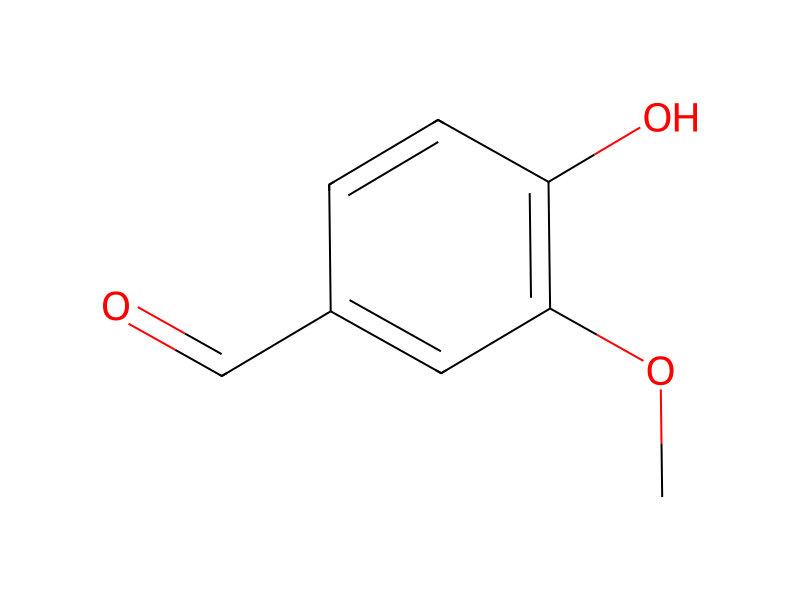
Vanillin → 3-Methoxy4-(3-trimethylsilanylpropyloxy)benzaldehyde
Reaction equation

Cl[CH2:2][CH2:3][CH2:4][Si:5]([CH3:8])([CH3:7])[CH3:6].[O:9]=[CH:10][C:11]1[CH:19]=[CH:18][C:16]([OH:17])=[C:13]([O:14][CH3:15])[CH:12]=1.C(=O)([O-])[O-].[K+].[K+]>CN(C=O)C>[CH3:15][O:14][C:13]1[CH:12]=[C:11]([CH:19]=[CH:18][C:16]=1[O:17][CH2:2][CH2:3][CH2:4][Si:5]([CH3:8])([CH3:7])[CH3:6])[CH:10]=[O:9]Participants
Reactant 3


Product 1

Reagents, catalysts & solvents 1

Conditions
- Temperature
- 80 °C
Procedure
3-chloropropyltrimethylsilane (33.14 g, 0.22 mol) was added dropwise over 20 minutes to a mixture of vanillin (30.4 g, 0.2 mol) and potassium carbonate (30.4 g, 0.22 mol) in 150 ml of dry DMF heated to 80° C. under nitrogen. The mixture was maintained for 4 hours at 95°-110° C. The reaction mixture was cooled and poured into ice-cold water. The aqueous phase was extracted three times with dichloromethane. The organic phases were dried over sodium sulfate and concentrated under vacuum. After distillation under vacuum (0.04 mm Hg), 47.5 g (yield: 89%) of 3-methoxy-4-(3-trimethylsilanylpropyloxy) benzaldehyde were obtained in the form of a slightly pinkish oil distilling at 112°-114° C. and employed without further purification in the following step.
Workup
- temperatureThe mixture was maintained for 4 hours at 95°-110° C
- temperatureThe reaction mixture was cooled
- additionpoured into ice-cold water
- extractionThe aqueous phase was extracted three times with dichloromethane
- dry with materialThe organic phases were dried over sodium sulfate
- concentrationconcentrated under vacuum
- distillationAfter distillation under vacuum (0.04 mm Hg)
Sources & evidence
- ORD record
- ord-bfc65781d7b8491b8a3844521f286065
- Source dataset
- uspto-grants-2002_08
- Patent number
- US06429326B1
Reaction notes
Loading…