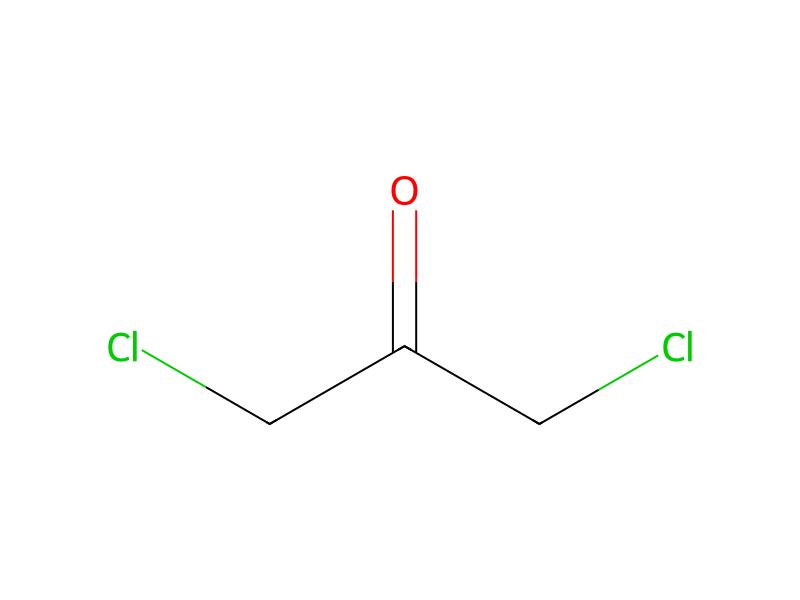
1,3-Dichloroacetone → 3-Chloro-2-oxopropyl triphenylphosphonium chloride
Reaction equation

[Cl:1][CH2:2][C:3]([CH2:5]Cl)=[O:4].[CH:7]1[CH:12]=[CH:11][C:10]([P:13]([C:20]2[CH:25]=[CH:24][CH:23]=[CH:22][CH:21]=2)[C:14]2[CH:19]=[CH:18][CH:17]=[CH:16][CH:15]=2)=[CH:9][CH:8]=1>C1COCC1.CCOCC>[Cl-:1].[Cl:1][CH2:2][C:3](=[O:4])[CH2:5][P+:13]([C:14]1[CH:15]=[CH:16][CH:17]=[CH:18][CH:19]=1)([C:20]1[CH:25]=[CH:24][CH:23]=[CH:22][CH:21]=1)[C:10]1[CH:9]=[CH:8][CH:7]=[CH:12][CH:11]=1Participants
Reactant 2

Product 1

Reagents, catalysts & solvents 2


Procedure
The procedure of Tome et al., Tetrahedron Letters, Volume 37, pp 6951-6954 (1996), was followed. 1,3-Dichloroacetone (8.0 g) and Ph3P (15.0 g) were stirred in THF (38 mL) at reflux for 4 h. The cooled suspension was diluted with ether, filtered and the solid was washed with ether and dried to give (3-chloro-2-oxopropyl)triphenylphosphonium chloride (20.86 g) as a white solid. This material was dissolved in a mixture of water (110 mL) and MeOH (110 mL) and treated with NaHCO3 (10.3 g). The resulting white precipitate was collected by filtration, washed with water and dried in vacuo to give 1-chloro-3-(triphenylphosphanylidene)-2-propanone (18.25 g). A solution of this phosphorane (18.2 g) and 3-chlorophenol (7.28 g) was stirred with K2CO3 (28.57 g) in DMSO (91 mL) at 62° C. for 18 h, then diluted with water (2 L), extracted with ether (3×1 L), dried (MgSO4), filtered and concentrated to give 1-(3-chlorophenoxy)-3-(triphenylphosphanylidene)-2-propanone (21.7 g) as a tan solid. 1H NMR (CDCl3): δ 4.02 (s, 2H), 4.23-4.35 (d, 1H), 7.42-7.72 (m, 15H).
Workup
- temperatureat reflux for 4 h
- filtrationfiltered
- washthe solid was washed with ether
- customdried
Sources & evidence
- ORD record
- ord-09d448c1e393481cad1596ed8753c940
- Source dataset
- uspto-grants-2004_12
- Patent number
- US06828444B2
Reaction notes
Loading…