Potassium Carbonate → HCID 9964216, compound
Reaction equation

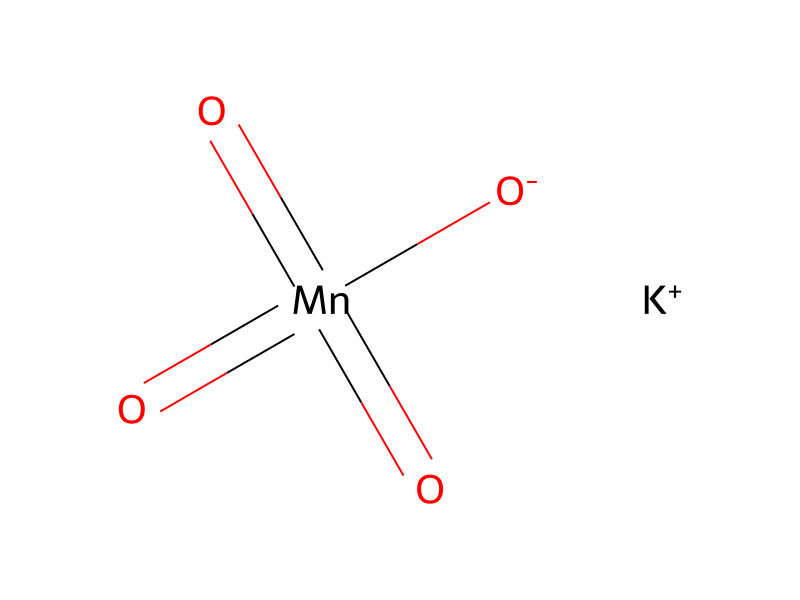
[CH3:1][CH:2]([CH2:4][C:5]([CH2:7][CH:8](C=C)[CH3:9])=[O:6])[CH3:3].[C:12](=[O:15])([O-])[O-:13].[K+].[K+].I([O-])(=O)(=O)=O.[K+].[Mn]([O-])(=O)(=O)=O.[K+].[K].[OH-].[K+]>O1CCOCC1.O>[CH3:9][CH:8]([CH2:7][C:5](=[O:6])[CH2:4][CH:2]([CH3:3])[CH3:1])[C:12]([OH:13])=[O:15]Participants
Reactant 6





Product 1

Reagents, catalysts & solvents 1

Conditions
- Temperature
- 6 °C
Procedure
(by conventional method): To a vigorously stirred solution of dihydrotagetone (4) (5 g, 33 mmole) in 1,4-dioxane-water (250 mL, 4:1) is added potassium carbonate (7 g,) followed by powdered potassium metaperiodate (15 g, 70 mmol) and then 0.25 g of powdered potassium permanganate. The remaining powdered potassium metaperiodate (35 g, 163.6 mmole) and potassium permnaganate (0.4-0.6 g) was added in small fractions within 30-40 minutes. The reaction mixture was left at room temperature for overnight and the solution, which was initially deep purple turned into light brown solution. The mixture was made alkaline with 10% potassium hydroxide and filtered and then residue was further washed with aqueous-dioxane mixture. The filtrate and washings were combined and the dioxane was evaporated under reduced pressure. The aqueous layer was extracted with ethylacetate (15 mL×2) to remove unwanted impurities. The aqueous layer was cooled at 4-8° C. and acidified with dilute acid and then extracted with ethylacetate (3×25 mL). The ethylacetate layers were then combined and washed with saturated sodium bisulphate (to destroy the excess permanganate), sodium chloride (3×15 m), dried over anhydrous sodium sulphate and filtered. The solvent was removed to afford a crude liquid which was loaded on silica gel column and the column was eluted with an increasing amount of hexane/ethyl acetate (100:0 to 95:5). The fractions were monitored on TLC plate and the desired fractions were combined and solvent was removed under vacuum to afford 2,6-dimethyl-4-oxo-heptanoic acid in 68% yield as a viscous liquid; Rf=0.69 (toluene:ethylacetate:methanol::6.5:3.5:0.1 mL); IR (film) λmax 2958, 1709, 1465, 1376, 937 cm−1; 1H NMR δ 10.53 (s, 1H, COOH), 3.03-2.94 (m, 1H, 2-CH), 2.91-2.82 (m, 1H, 6-CH), 2.50-2.06 (m, 4H, 3-CH2 and 5-CH2), 1.23-1.20 (d, 3H, 9-CH3), 0.99-0.97 and 0.92-0.90 (2d, 6H, 7-CH3 and 8-CH3)(FIG. 1); 13C NMR 208.66 (COOH, C-1), 181.94 (C═O, C-4), 51.71 (C-2), 45.89 (C-6), 34.39 (C-3), 24.54 (C-5), 22.39 (2×C-7 and C-8), 16.73 (C-9) (FIG. 2).
Workup
- filtrationfiltered
- washresidue was further washed with aqueous-dioxane mixture
- customthe dioxane was evaporated under reduced pressure
- extractionThe aqueous layer was extracted with ethylacetate (15 mL×2)
- customto remove unwanted impurities
- additionwith dilute acid
- extractionextracted with ethylacetate (3×25 mL)
- washwashed with saturated sodium bisulphate (
- customto destroy the excess permanganate), sodium chloride (3×15 m)
- dry with materialdried over anhydrous sodium sulphate
- filtrationfiltered
- customThe solvent was removed
- customto afford a crude liquid which
- washthe column was eluted with an increasing amount of hexane/ethyl acetate (100:0 to 95:5)
- customsolvent was removed under vacuum
Sources & evidence
- ORD record
- ord-fd25d737dbc84d54b0032596d358055f
- Source dataset
- uspto-grants-2004_12
- Patent number
- US06833475B2
Reaction notes
Loading…