Imidazole → HCID 20030823, compound
Reaction equation

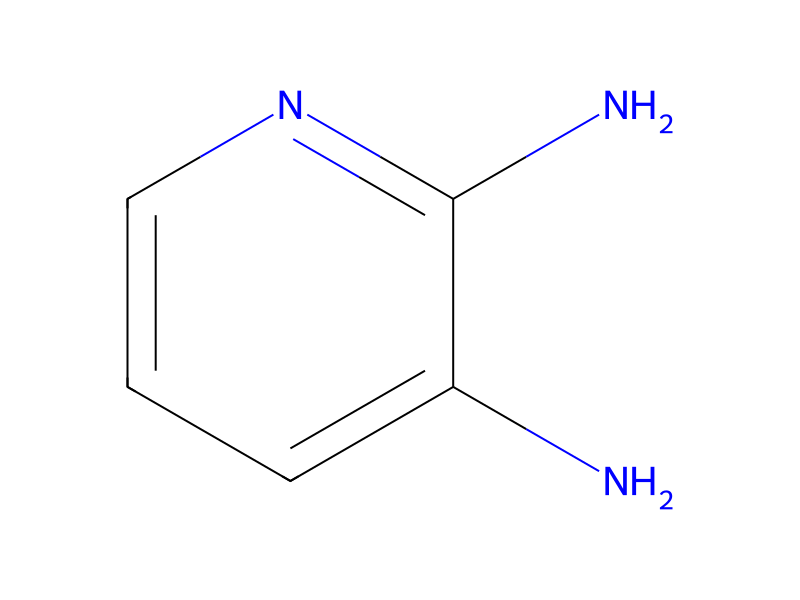
[C:1]([O:4][CH2:5][C:6](Cl)=[O:7])(=[O:3])[CH3:2].N1C=CN=C1.[NH2:14][C:15]1[C:20]([NH2:21])=[CH:19][CH:18]=[CH:17][N:16]=1.C(=O)(O)[O-].[Na+]>O1CCCC1>[C:1]([O:4][CH2:5][C:6]([NH:21][C:20]1[C:15]([NH2:14])=[N:16][CH:17]=[CH:18][CH:19]=1)=[O:7])(=[O:3])[CH3:2]Participants
Reactant 4



Product 1

Reagents, catalysts & solvents 1

Conditions
- Temperature
- -78 °C
Procedure
Acetoxyacetyl chloride (2.73 g, 20 mmol) was added dropwise to a stirred solution of imidazole (2.72 g, 40 mmol) in dry tetrahydrofuran (20 ml) under nitrogen at 0° C. After the addition was complete, the thick white suspension was cooled to --78° C. and a solution of 2,3-diaminopyridine (2.18 g, 20 mmol) in dry tetrahydrofuran (60 ml) was added over 10 minutes. The mixture was allowed to warm to room temperature overnight and then saturated aqueous sodium bicarbonate (100 ml) was added. The mixture was extracted with dichloromethane (3×80 ml), the extracts were dried (MgSO4) and concentrated under reduced pressure to give a brown solid. Recrystallisation from ethyl acetate gave 3-(acetoxyacetyl)amino-2-aminopyridine (795 mg, 38%) as white flakes.
Workup
- additionAfter the addition
- temperatureto warm to room temperature overnight
- extractionThe mixture was extracted with dichloromethane (3×80 ml)
- dry with materialthe extracts were dried (MgSO4)
- concentrationconcentrated under reduced pressure
- customto give a brown solid
- customRecrystallisation from ethyl acetate
Sources & evidence
- ORD record
- ord-86cfdd6da5534ca4b2a723b150318aec
- Source dataset
- uspto-grants-1989_07
- Patent number
- US04851412
Reaction notes
Loading…