4-Bromophenol → 1-Bromo-4-[(2-ethylhexyl)oxy]benzene
Reaction equation

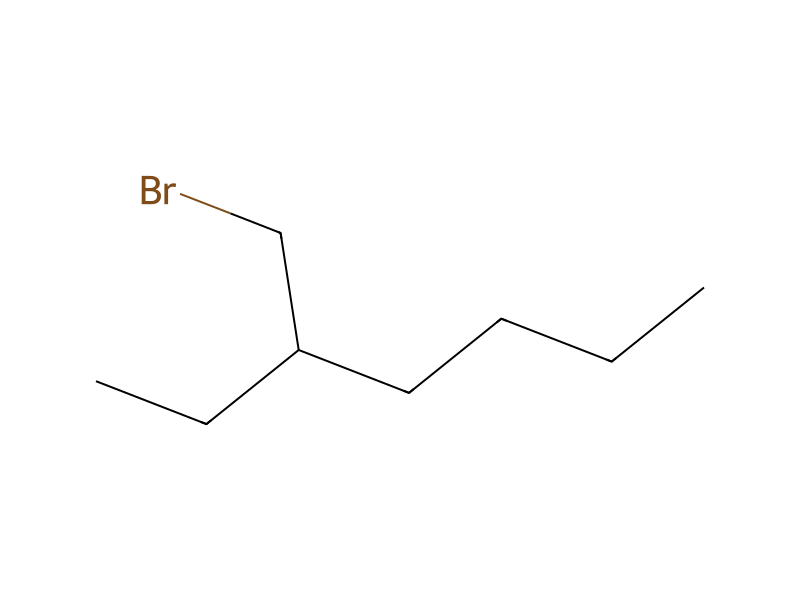
[Br:1][C:2]1[CH:7]=[CH:6][C:5]([OH:8])=[CH:4][CH:3]=1.[OH-].[Na+].Br[CH2:12][CH:13]([CH2:16][CH2:17][CH2:18][CH3:19])[CH2:14][CH3:15]>COCCO>[CH2:14]([CH:13]([CH2:16][CH2:17][CH2:18][CH3:19])[CH2:12][O:8][C:5]1[CH:6]=[CH:7][C:2]([Br:1])=[CH:3][CH:4]=1)[CH3:15]Participants
Reactant 3


Product 1

Reagents, catalysts & solvents 1

Conditions
- Temperature
- 60 °C
Procedure
A 1 l sulfonating flask equipped with stirrer, condenser, dropping funnel and internal thermometer is charged with 86.5 g (0.5 mol) of 4-bromophenol in 500 ml of methylcellosolve. After the mixture is heated to 60° C., 70.0 g of 30% NaOH (0.53 mol) are slowly run in. Stirring is continued for 15 minutes before 116.8 g (0.575 mol) of 3-bromomethylheptane are added dropwise over a period of 45 minutes. The reaction is continued overnight at 100° C. The thin-layer chromatogram shows almost quantitative conversion. Solvent and excess bromide are removed in vacuo, and the residue (oil) is taken up in 600 ml of toluene. The resulting solution is extracted three times with water. The organic phase is dried over sodium sulfate and evaporated to dryness to give 119.3 g (84% of theory) of 4-(2-ethylhexyloxy)bromobenzene as a light yellow oil.
Workup
- customequipped with stirrer, condenser
- additionare added dropwise over a period of 45 minutes
- customSolvent and excess bromide are removed in vacuo
- extractionThe resulting solution is extracted three times with water
- dry with materialThe organic phase is dried over sodium sulfate
- customevaporated to dryness
Sources & evidence
- ORD record
- ord-002a73c05dcb4467af5ba441018d7825
- Source dataset
- uspto-grants-1997_01
- Patent number
- US05591850
Reaction notes
Loading…