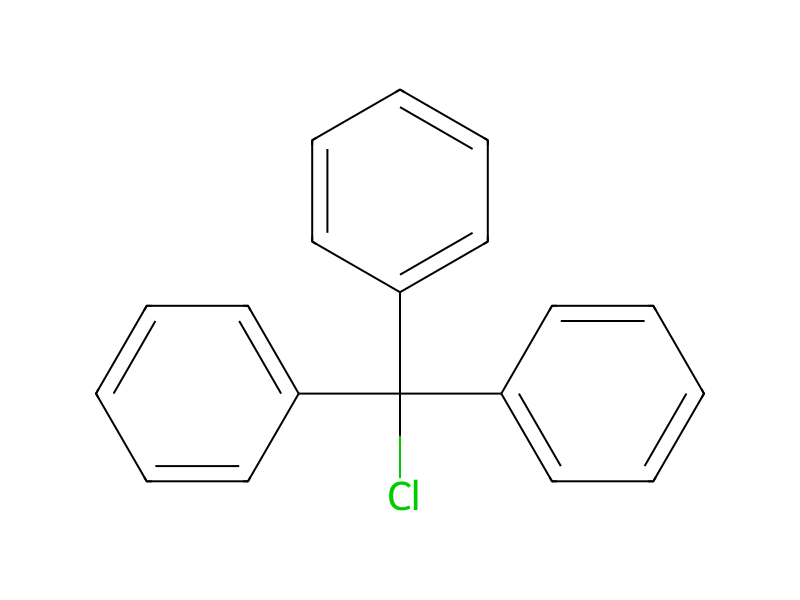
Trityl chloride → (S)-Glycidyl Trityl Ether
Reaction equation

[C:1](Cl)([C:14]1[CH:19]=[CH:18][CH:17]=[CH:16][CH:15]=1)([C:8]1[CH:13]=[CH:12][CH:11]=[CH:10][CH:9]=1)[C:2]1[CH:7]=[CH:6][CH:5]=[CH:4][CH:3]=1.C(N(CC)CC)C.[CH2:28]1[O:30][C@@H:29]1[CH2:31][OH:32]>C(Cl)Cl>[C:2]1([C:1]([C:14]2[CH:19]=[CH:18][CH:17]=[CH:16][CH:15]=2)([C:8]2[CH:13]=[CH:12][CH:11]=[CH:10][CH:9]=2)[O:32][CH2:31][C@@H:29]2[CH2:28][O:30]2)[CH:7]=[CH:6][CH:5]=[CH:4][CH:3]=1Participants
5
Reactant 3


Product 1

Reagents, catalysts & solvents 1

Conditions
- Temperature
- 0 °C
Procedure
A 5 L 3-neck round bottom flask was charged with trityl chloride (133.8 g, 0.48 mol) and methylene chloride (400 ml). It was cooled to 0° C. under N2 and treated with triethylamine (70.7 g, 0.70 mol). After an hour of stirring at 0° C., a solution of (R)-glycidol (88% ee, 37.03 g, 0.5 mol) in methylene chloride (100 ml) was added over 0.75 hour. The resulting solution was allowed to warm to ambient temperature and was stirred for 3 hours. It was then filtered, and the filtrate was washed with water (2×500 ml) and brine (2×500 ml). The organic phase was dried over MgSO4 and concentrated to a foam, which on crystallization from isopropyl alcohol gave the title compound (116.2 g, 76.5%) as an off-white powder.
Workup
- temperatureto warm to ambient temperature
- stirringwas stirred for 3 hours
- filtrationIt was then filtered
- washthe filtrate was washed with water (2×500 ml) and brine (2×500 ml)
- dry with materialThe organic phase was dried over MgSO4
- concentrationconcentrated to a foam, which on crystallization from isopropyl alcohol
Sources & evidence
- ORD record
- ord-1ffa11006af34deeaa93db64b2e45a5b
- Source dataset
- uspto-grants-1997_01
- Patent number
- US05591852
Reaction notes
Loading…