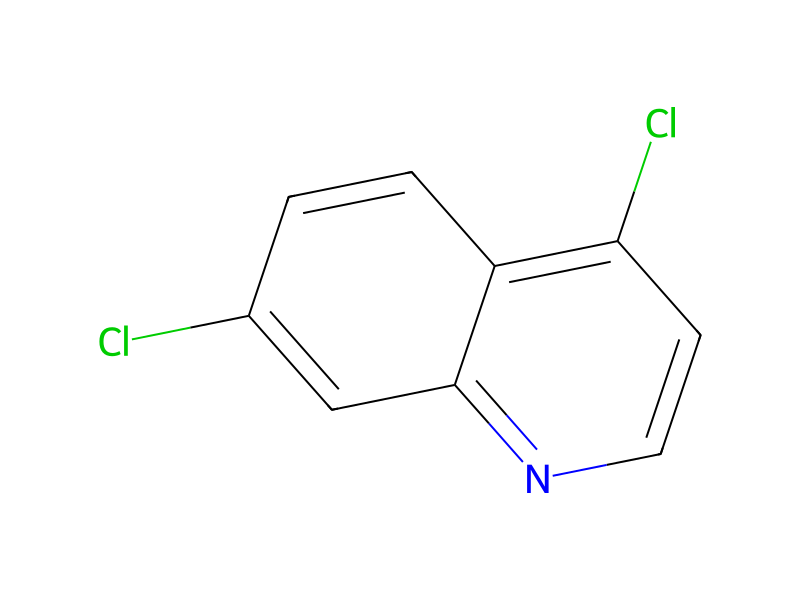
4,7-Dichloroquinoline → HCID 54478391, compound
Reaction equation

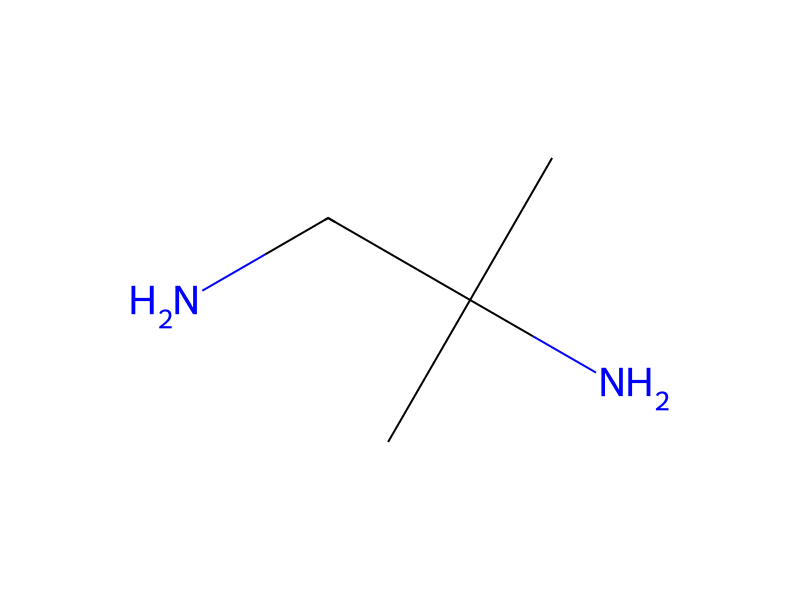
Cl[C:2]1[C:11]2[C:6](=[CH:7][C:8]([Cl:12])=[CH:9][CH:10]=2)[N:5]=[CH:4][CH:3]=1.[NH2:13][CH2:14][C:15]([NH2:18])([CH3:17])[CH3:16]>CN1CCCC1=O>[Cl:12][C:8]1[CH:7]=[C:6]2[C:11]([C:2]([NH:13][CH2:14][C:15]([CH3:17])([NH2:18])[CH3:16])=[CH:3][CH:4]=[N:5]2)=[CH:10][CH:9]=1Participants
4
Reactant 2
Product 1

Reagents, catalysts & solvents 1

Procedure
52.8 g of 4,7-dichloroquinoline and 30.85 g of 1,2-diamino-2-methylpropane were stirred in 530 ml of N-methyl-2-pyrrolidone under argon at 150° C. for 5 hours. Thereafter, the solvent was evaporated in a vacuum and the residue was taken up in 1250 ml of water. After adjustment to pH 1 using conc. hydrochloric acid, the mixture was extracted once with 200 ml of ethyl acetate and twice with 100 ml of ethyl acetate each time, and subsequently treated with about 170 ml of 30% potassium hydroxide solution until the pH reached 12. Thereby, 88 g of N1 -(7-chloro-quinolin-4-yl)-2-methyl-propane-1,2-diamine separate out in crystalline form; m.p.: 169°-171° C.
Workup
- customThereafter, the solvent was evaporated in a vacuum
- extractionthe mixture was extracted once with 200 ml of ethyl acetate and twice with 100 ml of ethyl acetate each time
- additionsubsequently treated with about 170 ml of 30% potassium hydroxide solution until the pH
- customThereby, 88 g of N1 -(7-chloro-quinolin-4-yl)-2-methyl-propane-1,2-diamine separate out in crystalline form
Sources & evidence
- ORD record
- ord-9222e8b1929e4cc2b943163590840e84
- Source dataset
- uspto-grants-1997_01
- Patent number
- US05596002
Reaction notes
Loading…