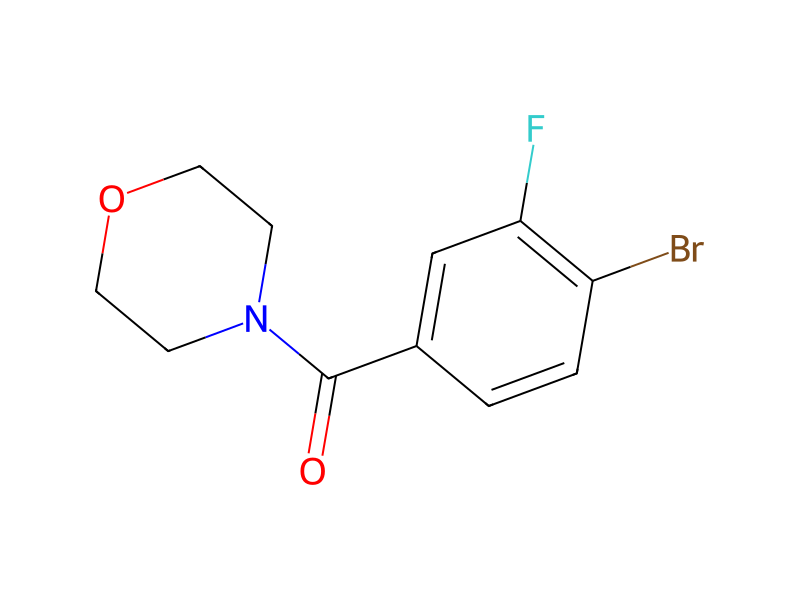
Water → (4-Bromo-3-fluorophenyl)(morpholin-4-yl)methanone
Reaction equation

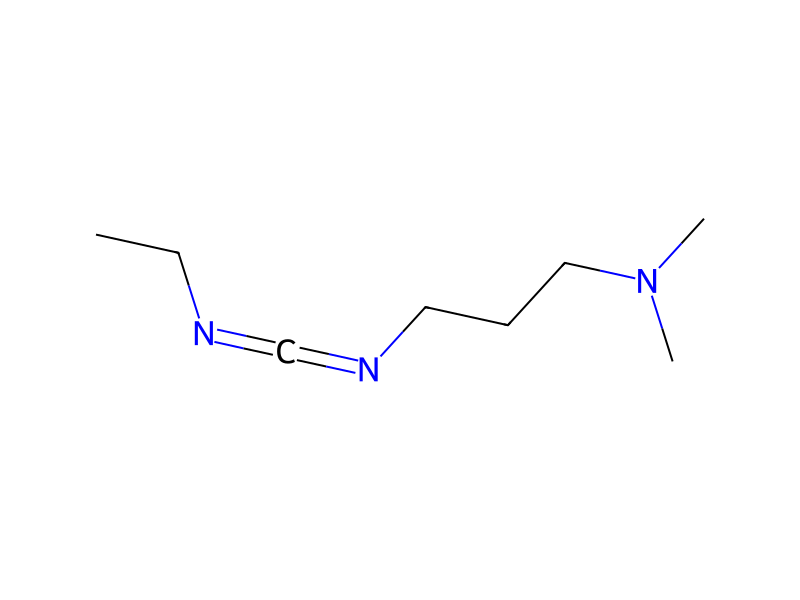
[Br:1][C:2]1[CH:10]=[CH:9][C:5]([C:6]([OH:8])=O)=[CH:4][C:3]=1[F:11].CCN=C=NCCCN(C)C.[NH:23]1[CH2:28][CH2:27][O:26][CH2:25][CH2:24]1.O>ClCCl.CN(C1C=CN=CC=1)C>[Br:1][C:2]1[CH:10]=[CH:9][C:5]([C:6]([N:23]2[CH2:28][CH2:27][O:26][CH2:25][CH2:24]2)=[O:8])=[CH:4][C:3]=1[F:11]Participants
Reactant 4



Product 1
Reagents, catalysts & solvents 2


Procedure
To a room temperature solution containing 10 g of 4-bromo-3-fluorobenzoic acid (45.7 mmols) in 228 mL of dichloromethane was added 1.67 g of DMAP (13.7 mmols), 11.3 g of EDCI (59.2 mmols), and 5.11 mL of morpholine (59.4 mmols). After stirring at ambient temperature for 18 h, 20 mL of water was added to the reaction mixture. The layers were separated, and the organic layer was washed with water (3×20 mL), dried over MgSO4, and filtered through a frit. The resulting solution was concentrated to a pale yellow oil which was purified by silica gel chromatography (120 g redisep column, silica 40 um, 60 A, 85 ml/min, A: EtOAc, B: hexanes, A: 50% for 5 min, then 50-70% for 8 min) to give 8.62 g (66%) of title compound as a yellow oil. MS (ES) m/e 288 [M+]+.
Workup
- customThe layers were separated
- washthe organic layer was washed with water (3×20 mL)
- dry with materialdried over MgSO4
- filtrationfiltered through a frit
- concentrationThe resulting solution was concentrated to a pale yellow oil which
- customwas purified by silica gel chromatography (120 g redisep column, silica 40 um, 60 A, 85 ml/min
- waitA: EtOAc, B: hexanes, A: 50% for 5 min
Sources & evidence
- ORD record
- ord-9524a70de2f749cdbbc3dacf1c61a808
- Source dataset
- uspto-grants-2010_07
- Patent number
- US07749998B2
Reaction notes
Loading…