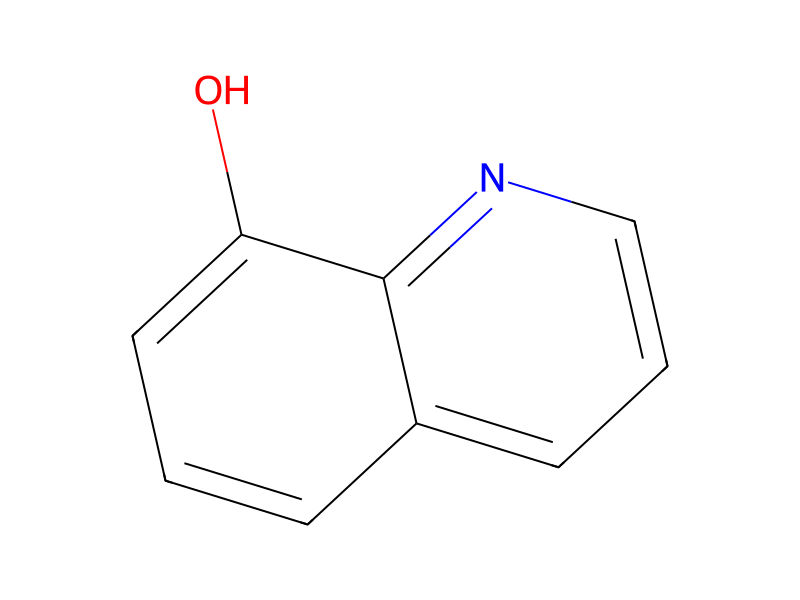
8-Hydroxyquinoline → 1-(4-Amino-3-fluorophenyl)pyridin-2-one
Reaction equation

[F:1][C:2]1[CH:8]=[C:7](I)[CH:6]=[CH:5][C:3]=1[NH2:4].[OH:10][C:11]1[CH:16]=[CH:15][CH:14]=[CH:13][N:12]=1.OC1C=CC=C2C=1N=CC=C2.C([O-])([O-])=O.[K+].[K+]>CS(C)=O.[Cu]I.C(O)CCC.O>[NH2:4][C:3]1[CH:5]=[CH:6][C:7]([N:12]2[CH:13]=[CH:14][CH:15]=[CH:16][C:11]2=[O:10])=[CH:8][C:2]=1[F:1]Participants
9
Reactant 4



Product 1

Reagents, catalysts & solvents 4




Conditions
- Temperature
- 130 °C
Procedure
A mixture of 2-fluoro-4-iodoaniline (3.00 g, 12.6 mmol), 2-hydroxypyridine 1-7 (1.20 g, 12.6 mmol), 8-hydroxyquinoline (0.184 , g, 1.26 mmol) and K2CO3 (3.49 g, 25.3 mmol) in DMSO (20 mL) was degassed with Ar before being charged with CuI (0.241 g, 1.27 mmol). The mixture in a sealed tube was heated at 130° C. overnight. After being cooled down to room temperature, H2O and nBuOH were added. The organic phase was separated, concentrated in vacuo to give 1-(4-amino-3-fluorophenyl)pyridin-2(1H)-one as a solid (2.31 g).
Workup
- customwas degassed with Ar
- temperatureAfter being cooled down to room temperature
- customThe organic phase was separated
- concentrationconcentrated in vacuo
Sources & evidence
- ORD record
- ord-26efcd42f9f44296a6355c29ff36125f
- Source dataset
- uspto-grants-2010_07
- Patent number
- US07763608B2
Reaction notes
Loading…