Dimethyl Sulfoxide → HCID 13879178, compound
Reaction equation

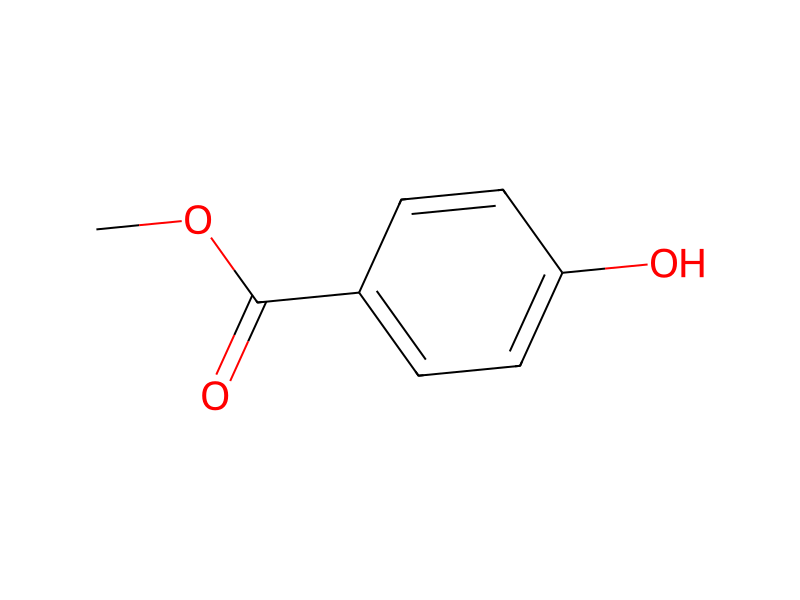
[CH3:1][O:2][C:3](=[O:11])[C:4]1[CH:9]=[CH:8][C:7]([OH:10])=[CH:6][CH:5]=1.[OH-].[Na+].[CH3:14]S(C)=O.Cl[CH2:19][CH2:20][CH2:21][Si:22](OC)([O:25][CH3:26])[O:23][CH3:24]>C1(C)C=CC=CC=1>[C:3]([C:4]1[CH:9]=[CH:8][C:7]([O:10][CH2:19][CH2:20][CH2:21][Si:22]([CH3:14])([O:25][CH3:26])[O:23][CH3:24])=[CH:6][CH:5]=1)([O:2][CH3:1])=[O:11]Participants
Reactant 4



Product 1

Reagents, catalysts & solvents 1

Conditions
- Temperature
- 115 °C
Procedure
Using the general procedure described in Example 1 a reactor was charged with 83.7 g (0.55 mole) of methyl-p-hydroxybenzoate, 43.28 g of a 50% by weight aqueous solution of sodium hydroxide (0.54 mole NaOH), 112 cc dimethylsulfoxide and 120 cc toluene. The resultant mixture was heated to the boiling point for six hours under a nitrogen atmosphere to remove all of the water present by azeotropic distillation. The reaction mixture was then allowed to cool to about 75° C. at which time 109 g (0.56 mole) of 3-chloropropyl trimethoxysilane were added dropwise while the reaction mixture was stirred. Following completion of the addition the reaction mixture was heated at 115° C. for about 16 hours, following which the mixture was allowed to cool and was filtered to remove any sold material. The solvents were then removed under a pressure of about 15 mm of mercury at a temperature of about 60° C. The pressure was then reduced to 2 mm of mercury and the material boiling from 230° to 235° C. was collected. The weight of this fraction was equivalent to a yield of 92% based on starting materials. Analysis by vapor phase chromatography indicated that the purity of the product was greater than 98%. The infrared and nuclear magnetic resonance spectra of the product was consistent with the proposed structure.
Workup
- customto remove all of the water present
- distillationby azeotropic distillation
- additionwere added dropwise while the reaction mixture
- additioncompletion of the addition the reaction mixture
- temperatureto cool
- filtrationwas filtered
- customto remove any sold material
- customThe solvents were then removed under a pressure of about 15 mm of mercury at a temperature of about 60° C
- customboiling from 230° to 235° C.
- customwas collected
Sources & evidence
- ORD record
- ord-bea347361cd24700be77155da900d1ad
- Source dataset
- uspto-grants-1987_02
- Patent number
- US04645844
Reaction notes
Loading…