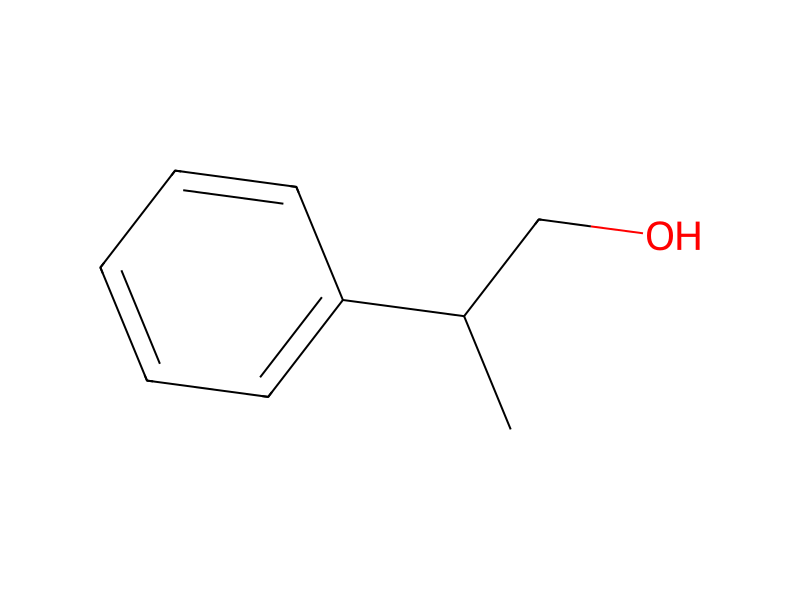
2-Phenylpropanal → 2-Phenyl-1-propanol
Reaction equation

C1(P(C2C=CC=CC=2)C2C=CC=CC=2)C=CC=CC=1.[OH-].[Na+].[C:22]1([CH:28]([CH3:31])[CH:29]=[O:30])[CH:27]=[CH:26][CH:25]=[CH:24][CH:23]=1.[H][H]>>[C:22]1([CH:28]([CH3:31])[CH2:29][OH:30])[CH:27]=[CH:26][CH:25]=[CH:24][CH:23]=1Participants
5




Procedure
Into a stainless steel autoclave equipped with a glass inner tube, Cu(NO3)(PPh3)2 (11.7 mg, 0.018 mmol) and triphenylphosphine (28.3 mg, 0.108 mmol) were introduced. The inside of the autoclave was then replaced with nitrogen. To the autoclave, an ethanolic solution of sodium hydroxide (0.03 M) (6.0 mL, 0.18 mmol) and 2-phenylpropionaldehyde (1.21 mL, 9 mmol) were added, and stirring was performed at a hydrogen pressure of 5 MPa at 50° C. for 16 hours. The hydrogen was released with great care, and the conversion was analyzed by GC (95%). The contents were concentrated, and then purified by silica gel chromatography. Thus, 715 mg of 2-phenyl-1-propanol was obtained (yield: 58%).
Workup
- concentrationThe contents were concentrated
- custompurified by silica gel chromatography
Sources & evidence
- ORD record
- ord-35a4b94d19ec494a913a286a0e1d94ff
- Source dataset
- uspto-grants-2014_04
- Patent number
- US08697881B2
Reaction notes
Loading…