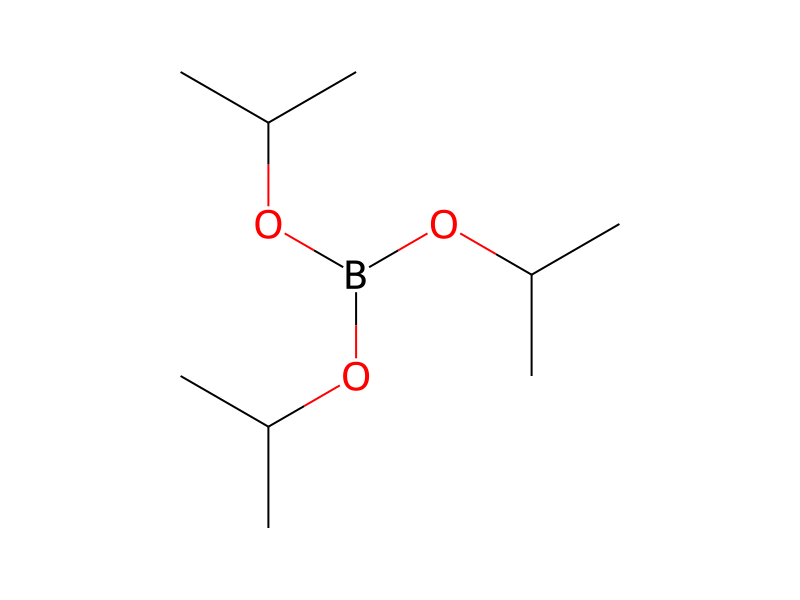
Triisopropyl borate → HCID 66691352, compound
Reaction equation

Br[C:2]1[C:7]([O:8][CH2:9][CH3:10])=[CH:6][CH:5]=[CH:4][C:3]=1[CH:11]1[O:15][CH2:14][CH2:13][O:12]1.[Li]CCCC.[B:21](OC(C)C)([O:26][CH:27]([CH3:29])[CH3:28])[O:22][CH:23]([CH3:25])[CH3:24]>C1COCC1>[O:12]1[CH2:13][CH2:14][O:15][CH:11]1[C:3]1[CH:4]=[CH:5][CH:6]=[C:7]([O:8][CH2:9][CH3:10])[C:2]=1[B:21]([O:26][CH:27]([CH3:29])[CH3:28])[O:22][CH:23]([CH3:25])[CH3:24]Participants
Reactant 3


Product 1

Reagents, catalysts & solvents 1

Conditions
- Temperature
- -78 °C
Procedure
To the solution of 2-(2-bromo-3-ethoxyphenyl)-1,3-dioxolane (132 g, 0.48 mol) in anhydrous THF (500 mL) was dropwise added n-BuLi (2.5 M in THF, 386 mL, 0.97 mol) at −78° C. under nitrogen protection. The mixture was stirred at −78° C. for 2 h and then triisopropyl borate (227 mL, 0.97 mol) was dropwise added. The resulting mixture was stirred at this temperature for 4 h. After the reaction was quenched by adding saturated aqueous NH4Cl solution (200 mL), the resulting mixture was extracted with EtOAc (3×300 mL). The combined organic layers were washed with water (200 mL) and brine (200 mL), dried over anhydrous Na2SO4 and concentrated to dryness. The residue was purified by column chromatography on silica gel to give the target compound (136 g, yield 87%).
Workup
- customat −78° C.
- stirringThe resulting mixture was stirred at this temperature for 4 h
- customAfter the reaction was quenched
- additionby adding saturated aqueous NH4Cl solution (200 mL)
- extractionthe resulting mixture was extracted with EtOAc (3×300 mL)
- washThe combined organic layers were washed with water (200 mL) and brine (200 mL)
- dry with materialdried over anhydrous Na2SO4
- concentrationconcentrated to dryness
- customThe residue was purified by column chromatography on silica gel
Sources & evidence
- ORD record
- ord-368a649f2a164185ad57c1caf5ddfc5b
- Source dataset
- uspto-grants-2014_04
- Patent number
- US08703742B2
Reaction notes
Loading…