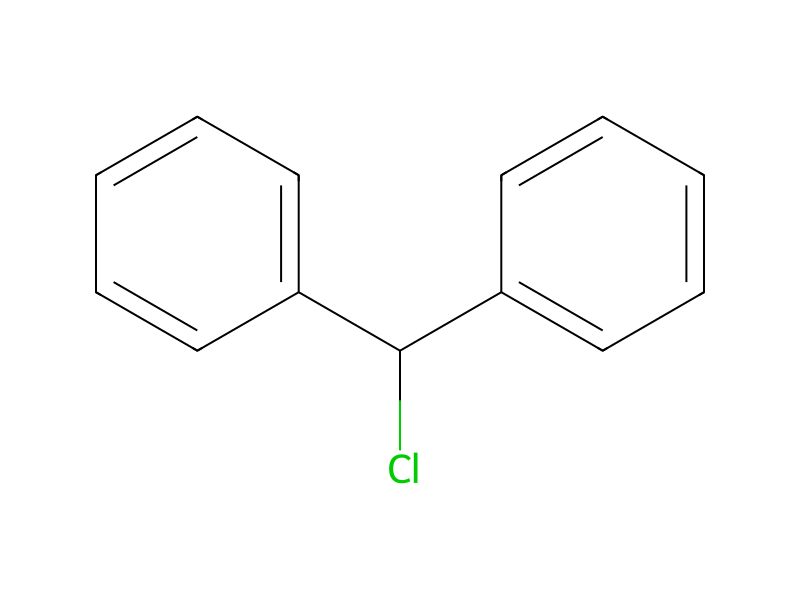
Phosgene → Chlorodiphenylmethane
Reaction equation

C(Cl)([Cl:3])=O.C(=O)([O-])[O-].[K+].[K+].[C:11]1([CH:17]([C:31]2[CH:36]=[CH:35][CH:34]=[CH:33][CH:32]=2)N2CC(OC3C=CC(Cl)=C(Cl)C=3)C2)[CH:16]=[CH:15][CH:14]=[CH:13][CH:12]=1>C(Cl)Cl>[C:11]1([CH:17]([Cl:3])[C:31]2[CH:36]=[CH:35][CH:34]=[CH:33][CH:32]=2)[CH:16]=[CH:15][CH:14]=[CH:13][CH:12]=1Participants
Reactant 3



Product 1
Reagents, catalysts & solvents 1

Procedure
A solution of 14 g (0.144 mole) of phosgene weighed into 200 mL of methylene chloride was treated with 19.9 g (0.144 mole) of anhydrous potassium carbonate and stirred for 1 h then 45.9 g (0.12 mole) of 1-(diphenylmethyl)-3-(3,4-dichlorophenoxy)azetidine in 100 mL of methylene chloride was added dropwise and stirring was continued for 72 h. The reaction mixture was filtered to remove the inorganic salts and then concentrated in vacuo to a pale yellow oil (67 g). Trituration of the residue with cyclohexane yielded a crude pale yellow solid (23.6 g). The filtrate was treated with ligroin and upon standing an additional 13.3 g of tacky material was obtained (contaminated with diphenylmethyl chloride). After several recrystallizations from cyclohexane to remove traces of diphenylmethyl chloride a portion was obtained as fine white crystals, mp 96°-99° C.
Workup
- stirringstirring
- waitwas continued for 72 h
- filtrationThe reaction mixture was filtered
- customto remove the inorganic salts
- concentrationconcentrated in vacuo to a pale yellow oil (67 g)
- customTrituration of the residue with cyclohexane yielded a crude pale yellow solid (23.6 g)
Sources & evidence
- ORD record
- ord-9d5dea734c5d46a78802889e70874952
- Source dataset
- uspto-grants-1992_03
- Patent number
- US05095014
Reaction notes
Loading…