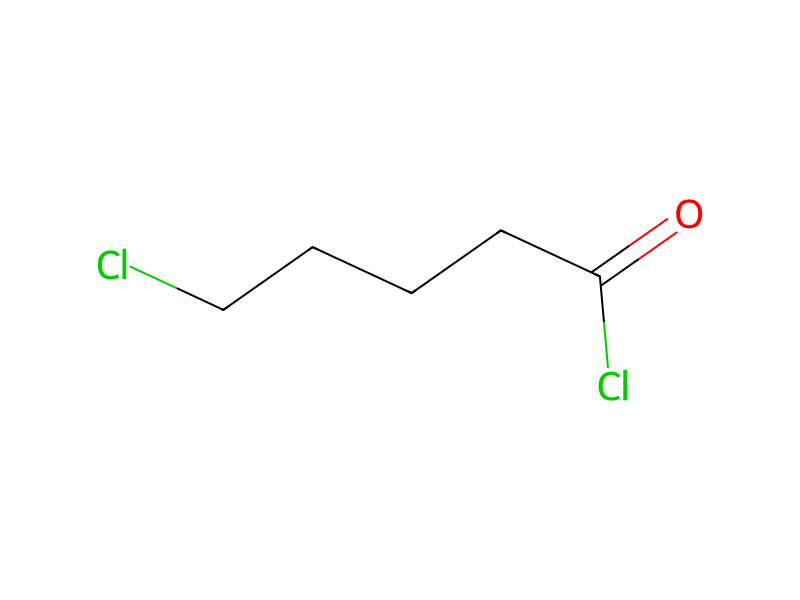
5-Chlorovaleryl chloride → 8-(5-chloropentanoyl)-5,6-dihydro-1H-pyrrolo[3,2,1-ij]quinolin-4(2H)-one
Reaction equation

[Cl-].[Al+3].[Cl-].[Cl-].[CH2:5]1[C:15]2=[C:16]3[C:11](=[CH:12][CH:13]=[CH:14]2)[CH2:10][CH2:9][C:8](=[O:17])[N:7]3[CH2:6]1.[Cl:18][CH2:19][CH2:20][CH2:21][CH2:22][C:23](Cl)=[O:24]>ClCCCl>[Cl:18][CH2:19][CH2:20][CH2:21][CH2:22][C:23]([C:13]1[CH:12]=[C:11]2[C:16]3=[C:15]([CH2:5][CH2:6][N:7]3[C:8](=[O:17])[CH2:9][CH2:10]2)[CH:14]=1)=[O:24]Participants
5




Procedure
Aluminum chloride (55 g, 410 mmol) was added by portions to a solution of 1,2,5,6-tetrahydro-4H-pyrrolo[3,2,1-ij]quinolin-4-one (30.0 g) and 5-chlorovaleryl chloride (26.8 ml) in 1,2-dichloroethane (70 ml) under ice-cooling. After stirring at room temperature for 30 minutes, the reaction mixture was poured into ice (500 g), extracted with ethyl acetate, and washed with brine. The organic layer was dried over anhydrous magnesium sulfate, the solvent was evaporated under reduced pressure, and the residue was recrystallized from ethanol-diethyl ether to give a pale yellow solid (36.5 g). Further recrystallization from ethanol-diethyl ether afforded the title compound as colorless crystals (32.4 g) having a melting point of 110-111° C.
Workup
- temperaturecooling
- extractionextracted with ethyl acetate
- washwashed with brine
- dry with materialThe organic layer was dried over anhydrous magnesium sulfate
- customthe solvent was evaporated under reduced pressure
- customthe residue was recrystallized from ethanol-diethyl ether
Sources & evidence
- ORD record
- ord-203f9fa9bcbd4d2fbb38a6c2cb7a2eb6
- Source dataset
- uspto-grants-2008_12
- Patent number
- US07462628B2
Reaction notes
Loading…