4-Coumaric acid → 4-Vinylphenol
Reaction equation

[OH:1][C:2]1[CH:12]=[CH:11][C:5]([CH:6]=[CH:7]C(O)=O)=[CH:4][CH:3]=1.C([O-])(=O)C.[K+].COC1C=CC(O)=CC=1>CN(C)C(=O)C>[OH:1][C:2]1[CH:12]=[CH:11][C:5]([CH:6]=[CH2:7])=[CH:4][CH:3]=1Participants
Reactant 3

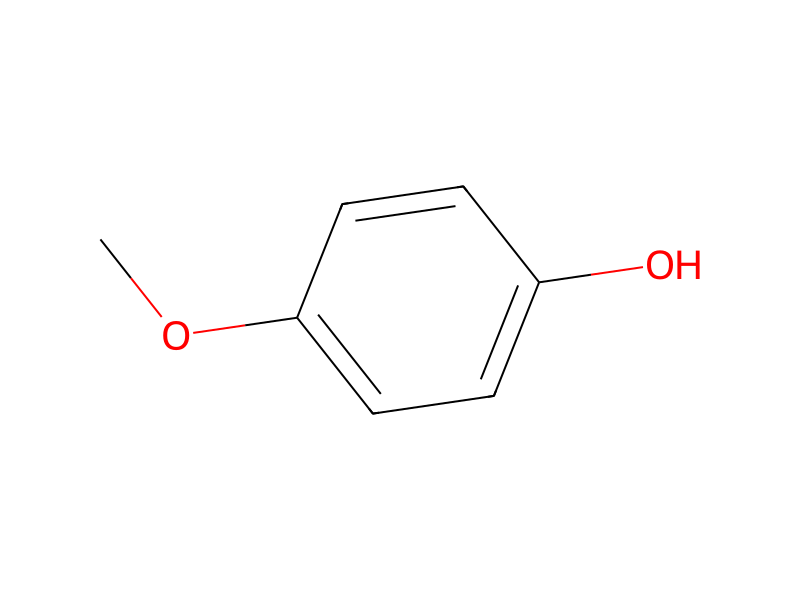

Product 1
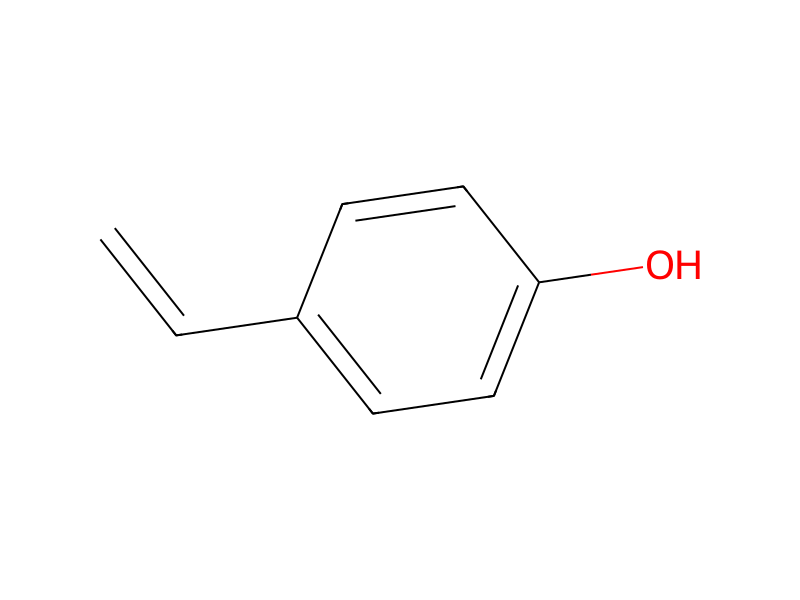
Reagents, catalysts & solvents 1

Procedure
Into a three neck 1 Liter flask equipped with a mechanical overhead stirrer and water condenser under an atmosphere of Nitrogen, was added 100 g (0.609 Mole) of p-hydroxycinnamic acid (TCI America; Portland, Oreg.) followed by 316 ml of N,N-Dimethylacetamide. The solution was stirred to form a light tan solution. To the solution was added 2.98 g of potassium acetate (Aldrich; Milwaukee, Wis.) (5 Mole %) followed by 0.1 g of 4-methoxyphenol (200 ppm; Aldrich; Milwaukee, Wis.). The flask was lowered into an oil bath preheated to 150° C. The reaction progress was monitored by HPLC as described in General Methods. The reaction mixture turned dark brown in color. Complete decarboxylation of p-hydroxycinnamic acid occurred in 4.5 h to give a solution of p-hydroxystyrene (HSM). The flask was then removed from the oil bath and allowed to cool to 40° C. To the reaction mixture was added 34.2 g finely ground potassium hydroxide, followed by rapid addition of 333.6 mL (7 equivalents) of epichlorohydrin (Aldrich). The reaction mixture turned yellow. The flask was lowered into a 90° C. oil bath. Reaction progress was monitored by HPLC. The p-hydroxystyrene was completely consumed in 80 min. with formation of p-glycidyloxystyrene, 68.07% yield based on HPLC. The reaction mixture was cooled to room temperature then filtered through a medium sintered funnel. The solids were washed with a small portion of DMAc and then with diethylether. Prostab® 5415 (1000 ppm; (bis(1-oxyl-2,2,6,6-tetramethylpiperidine-4-yl)sebacate; Ciba Specialty Chemicals, Tarrytown, N.Y.) was added and the mixture concentrated via rotovap at 40° C. The product was purified by vacuum distillation. The product fractions were collected at 98-100° C. and 2.2×10⁻² Torr. Fractions were analyzed by 1H NMR in CDCl3 as described in General Methods. The fractions with good product were combined to produce total of 64.2 g of clear liquid.
Workup
- customInto a three neck 1 Liter flask equipped with a mechanical overhead stirrer and water condenser under an atmosphere of Nitrogen
- customto form a light tan solution
- customThe flask was lowered into an oil bath
- custompreheated to 150° C
Sources & evidence
- ORD record
- ord-3b345883642145a9b8f5b552fb2f7b87
- Source dataset
- uspto-grants-2008_12
- Patent number
- US07468415B2
Reaction notes
Loading…