Water → N,N-Dimethyl-1H-indazole-3-carboxamide
Reaction equation

[NH:1]1[C:9]2[C:4](=[CH:5][CH:6]=[CH:7][CH:8]=2)[C:3]([C:10]([OH:12])=O)=[N:2]1.[CH3:13][NH2+:14][CH3:15].ON1C2C=CC=CC=2N=N1.Cl.C(N=C=NCCCN(C)C)C.O>C1COCC1>[CH3:13][N:14]([CH3:15])[C:10]([C:3]1[C:4]2[C:9](=[CH:8][CH:7]=[CH:6][CH:5]=2)[NH:1][N:2]=1)=[O:12]Participants
Reactant 4

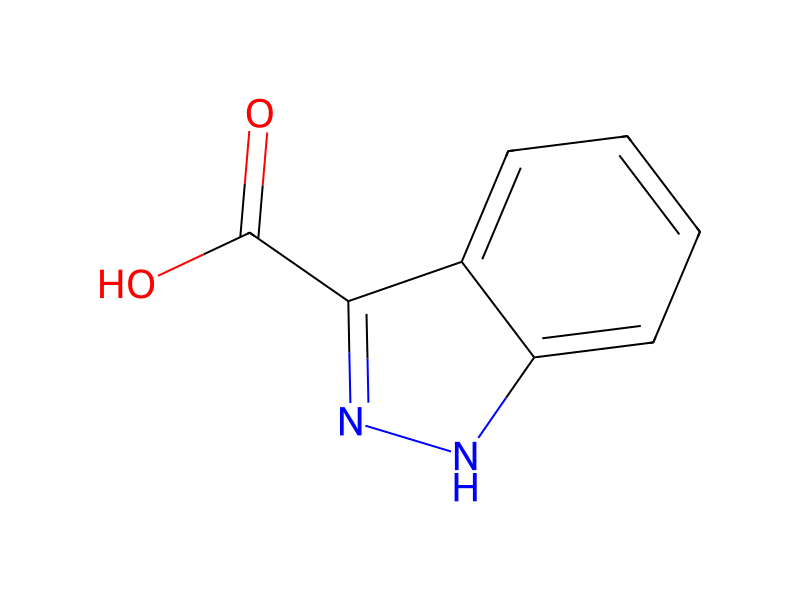


Product 1

Reagents, catalysts & solvents 1

Procedure
1H-indazole-3-carboxylic acid (45.2 g, 279 mmol) was suspended in THF (500 mL), and to the suspension were added 1-hydroxybenzotriazole dimethylammonium salt (55.7 g, 308 mmol) obtained in a similar manner to the known method [for example, Synthesis, page 285 (1992)] and 1-ethyl-3-(3-dimethylaminopropyl)carbodiimide hydrochloride (58.9 g, 307 mmol), followed by stirring at room temperature overnight. The reaction mixture was added with water, was extracted with ethyl acetate, and the organic layer was sequentially washed with a saturated aqueous sodium hydrogencarbonate solution and saturated brine, was dried over anhydrous sodium sulfate, and the solvent was evaporated under reduced pressure. The residue was recrystallized from mixed solvent of acetone/water to obtain N,N-dimethyl-1H-indazole-3-carboxamide (37.7 g, 71%).
Workup
- extractionwas extracted with ethyl acetate
- washthe organic layer was sequentially washed with a saturated aqueous sodium hydrogencarbonate solution and saturated brine
- dry with materialwas dried over anhydrous sodium sulfate
- customthe solvent was evaporated under reduced pressure
- customThe residue was recrystallized
- additionfrom mixed solvent of acetone/water
Sources & evidence
- ORD record
- ord-2cc260eafd3249c8af2d19b969e329f3
- Source dataset
- uspto-grants-2008_12
- Patent number
- US07470717B2
Reaction notes
Loading…