Trifluoroacetic acid → Ethyl 1-benzylpyrrolidine-3-carboxylate
Reaction equation

[C:1]([O:5][CH2:6][CH3:7])(=[O:4])[CH:2]=[CH2:3].[CH2:8]([N:15]([CH2:21]OC)[CH2:16][Si](C)(C)C)[C:9]1[CH:14]=[CH:13][CH:12]=[CH:11][CH:10]=1.FC(F)(F)C(O)=O>ClCCl>[CH2:8]([N:15]1[CH2:16][CH2:3][CH:2]([C:1]([O:5][CH2:6][CH3:7])=[O:4])[CH2:21]1)[C:9]1[CH:10]=[CH:11][CH:12]=[CH:13][CH:14]=1Participants



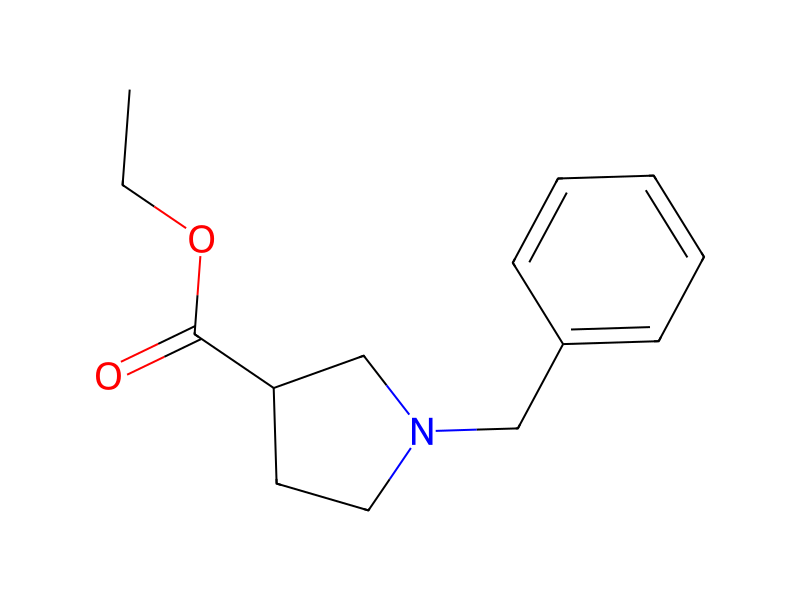

Procedure
To a stirred solution of ethyl acrylate (141 g, 1.41 mole) and N-benzyl-N-(methoxymethyl)-N-[(trimethylsilyl)methyl]amine (Compound D17 of EP 0363085, 435 g, containing approximately 75% of D17, 1.4 moles) in dichloromethane (2.5L) at -5° C. was added trifluoroacetic acid (16.1 g, 0.14 mole) in dichloromethane (100 ml) ensuring that the temperature did not rise above 0° C. This mixture was then transferred by cannula to stirred, refluxing dichloromethane (50 ml) over 40 minutes at such a rate as to maintain gentle reflux. The reaction mixture was then refluxed for a further 1h before cooling to room temperature. It was then washed with saturated aqueous potassium carbonate, dried (Na2SO4), and concentrated in vacuo to a gum which was distilled to afford the title compound (D1) as a clear oil (286 g, 88%) b.p. 120°-150° C. at 4 mmHg.
Workup
- customdid not rise above 0° C
- temperatureto maintain gentle reflux
- washIt was then washed with saturated aqueous potassium carbonate
- dry with materialdried (Na2SO4)
- concentrationconcentrated in vacuo to a gum which
- distillationwas distilled
Sources & evidence
- ORD record
- ord-8e6e8e909dfe4b44a99a3d092e96659e
- Source dataset
- uspto-grants-1994_11
- Patent number
- US05362739
Reaction notes
Loading…