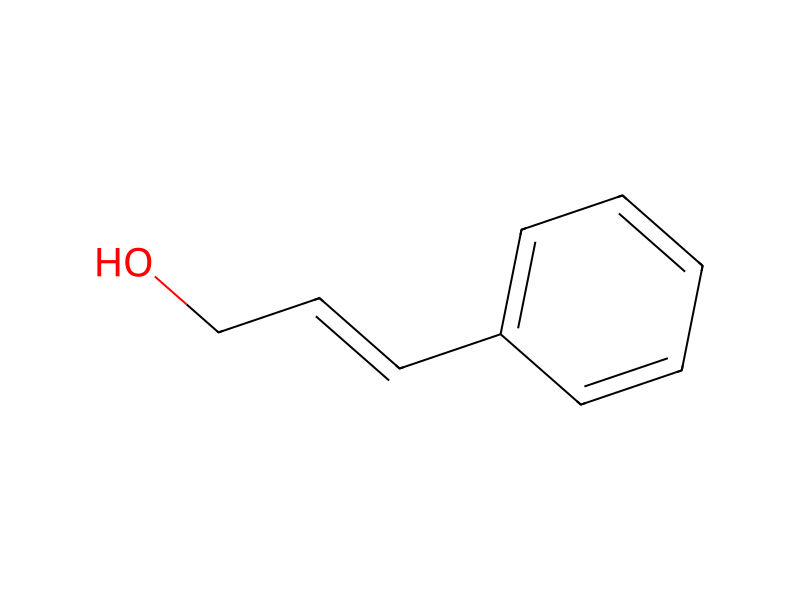
3-Phenylprop-2-En-1-Ol → 3-Phenylpropionate ion(1-)
Reaction equation

[CH2:1]([OH:10])[CH:2]=[CH:3][C:4]1[CH:9]=[CH:8][CH:7]=[CH:6][CH:5]=1.[OH-:11].[Na+].[OH2:13]>[Ni].[Cu].[Mo]>[C:4]1([CH2:3][CH2:2][C:1]([O-:11])=[O:10])[CH:9]=[CH:8][CH:7]=[CH:6][CH:5]=1.[C:4]1([CH2:3][CH2:2][CH2:1][OH:10])[CH:9]=[CH:8][CH:7]=[CH:6][CH:5]=1.[C:3]([O-:13])(=[O:11])[C:4]1[CH:9]=[CH:8][CH:7]=[CH:6][CH:5]=1Participants
9







Conditions
- Temperature
- 170 °C
Procedure
Into a 300 ml nickel autoclave was charged cinnamyl alcohol (50.0 g, 0.373 mol), sodium hydroxide (34.59 g, 0.432 mol) Raney copper containing about 70 ppm molybdenum (12.81 g copper suspended in 48.6 g water) and water (75 g). The autoclave was sealed and purged with nitrogen. The autoclave was heated under pressure to 170° C. for about 18 hours. The reaction products were filtered and the basic filtrate was extracted with diethyl ether. The aqueous phase was acidified and extracted with ether. The acid and base extracts were evaporated and analyzed. The reaction yielded 3-phenylpropionate (69%), 3-phenylpropanol (25%) and benzoate (8%) with 96% closure.
Workup
- customThe autoclave was sealed
- custompurged with nitrogen
- filtrationThe reaction products were filtered
- extractionthe basic filtrate was extracted with diethyl ether
- extractionextracted with ether
- customThe acid and base extracts were evaporated
Sources & evidence
- ORD record
- ord-f616167040ec4dcb90bcb9bb1676d01c
- Source dataset
- uspto-grants-1994_11
- Patent number
- US05367112
Reaction notes
Loading…