Hydrazine hydrate (1:1) → ethyl 2-hydrazino-4-methyl-1,3-thiazole-5-carboxylate
Reaction equation

Br[C:2]1[S:3][C:4]([C:8]([O:10][CH2:11][CH3:12])=[O:9])=[C:5]([CH3:7])[N:6]=1.O.[NH2:14][NH2:15]>O1CCCC1>[NH:14]([C:2]1[S:3][C:4]([C:8]([O:10][CH2:11][CH3:12])=[O:9])=[C:5]([CH3:7])[N:6]=1)[NH2:15]Participants
4
Reactant 2

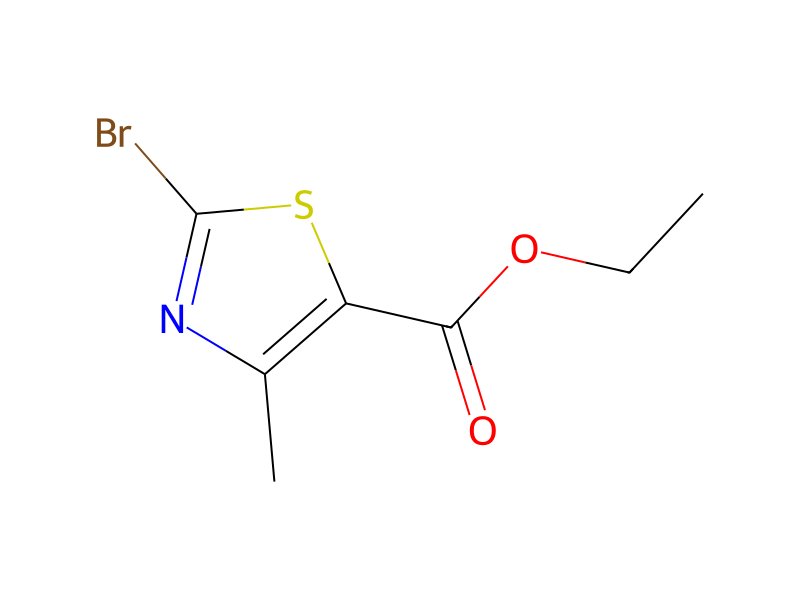
Product 1

Reagents, catalysts & solvents 1

Procedure
A To a stirred solution of ethyl 2-bromo-4-methylthiazole-5-carboxylate (10.00 g, 40.00 mmol) in tetrahydrofuran (125 mL), was added hydrazine monohydrate (6.01 g, 120.0 mmol). The reaction mixture was stirred at ambient temperature for 18 hours, concentrated in vacuo to dryness. The residue was purified by column chromatography to afford ethyl 2-hydrazinyl-4-methylthiazole-5-carboxylate as a white solid (11.06 g, 91%): 1H NMR (300 MHz, DMSO-d6) δ 5.02 (s, 2H), 4.13 (q, J=6.0 Hz, 2H), 2.33 (s, 3H), 1.18 (t, J=6.0 Hz, 3H); MS (ES+) m/z 202.2 (M+1).
Workup
- concentrationconcentrated in vacuo to dryness
- customThe residue was purified by column chromatography
Sources & evidence
- ORD record
- ord-3ca8f940d37c4c9b8e144676639a78c4
- Source dataset
- uspto-grants-2012_09
- Patent number
- US08258160B2
Reaction notes
Loading…