Hydrochloric Acid → 4-nitrophenyl (2S)-1,1,1-trifluoropropan-2-yl carbonate
Reaction equation

[F:1][C:2]([F:7])([F:6])[C@@H:3]([OH:5])[CH3:4].Cl[C:9]([O:11][C:12]1[CH:17]=[CH:16][C:15]([N+:18]([O-:20])=[O:19])=[CH:14][CH:13]=1)=[O:10].CN(C)CCO.Cl>C(Cl)(Cl)Cl.N1C=CC=CC=1>[C:9](=[O:10])([O:5][C@@H:3]([CH3:4])[C:2]([F:7])([F:6])[F:1])[O:11][C:12]1[CH:13]=[CH:14][C:15]([N+:18]([O-:20])=[O:19])=[CH:16][CH:17]=1Participants
7
Reactant 4


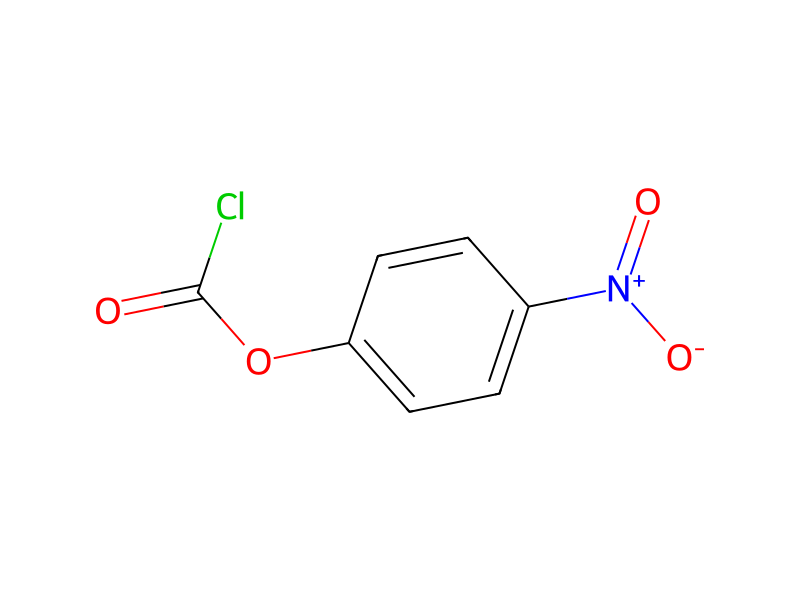

Product 1

Reagents, catalysts & solvents 2


Conditions
- Temperature
- 60 °C
Procedure
To a solution of (S)-(−)-1,1,1-trifluoro-2-propanol (1.95 g) in CHCl3 (30 mL) was added 4-nitrophenyl chloroformate (5.16 g) and pyridine (1.35 g) at room temperature. After 1-hour stirring at 60° C., the resulting mixture was cooled to room temperature. To the resulting mixture was added 2-(dimethylamino)ethanol (1.52 g) and was stirred at room temperature for 1 hour. The mixture was poured into 1M aqueous solution of HCl and extracted with CHCl3. The extract was washed with water and then dried over Na2SO4 and concentrated. The residue was purified with silica gel column chromatography (eluent: hexane/EtOAc=1/0˜50/50) to give 4-nitrophenyl (2S)-1,1,1-trifluoropropan-2-yl carbonate as a pale yellow foam.
Workup
- temperaturethe resulting mixture was cooled to room temperature
- stirringwas stirred at room temperature for 1 hour
- extractionextracted with CHCl3
- washThe extract was washed with water
- dry with materialdried over Na2SO4
- concentrationconcentrated
- customThe residue was purified with silica gel column chromatography (eluent: hexane/EtOAc=1/0˜50/50)
Sources & evidence
- ORD record
- ord-ffd16b7b54ad4f48a25e24851b9059b6
- Source dataset
- uspto-grants-2012_09
- Patent number
- US08263632B2
Reaction notes
Loading…