Hydrochloric Acid → (2R,3S,4R,5R)-2,3,4,5,6-pentahydroxyhexanal
Reaction equation

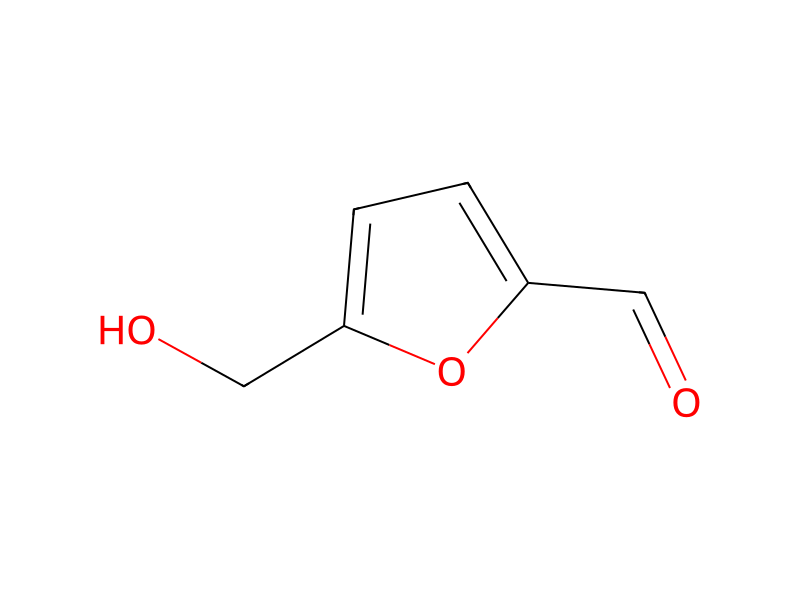
Cl.ClCl.[O:4]=[CH:5][C@@H:6]([C@H:8]([C@@H:10]([C@@H:12]([CH2:14][OH:15])[OH:13])[OH:11])[OH:9])[OH:7]>CCOCC>[CH:10]1[CH:8]=[C:6]([CH:5]=[O:4])[O:13][C:12]=1[CH2:14][OH:15].[O:4]=[CH:5][C@@H:6]([C@H:8]([C@@H:10]([C@@H:12]([CH2:14][OH:15])[OH:13])[OH:11])[OH:9])[OH:7]Participants




Procedure
Only the most inert ether solvents have the least reactivity to give the ring opened chlorinated byproducts. Even traces of chlorinated compounds are highly undesired in fuels. Besides wreaking havoc on the catalyst and equipment in a typical distillation refinery, the hydrochloric acid byproduct from combustion of chlorine containing fuels would be corrosive to the internal combustion engines as well as to the environment. The ketose sugars (fructose and sorbose) are known to be cyclo-dehydrated much easier than the aldose sugars (glucose). However, the ketoses are much more expensive, because they are normally derived from the aldose sugars. In his method, Hales obtained a 42% yield to 5-HMF from glucose (an aldose sugar) using an AlCl3 catalyst at 210° C. Hales did not disclose any biopolymers such as hemicellulose, starch or cellulose, nor did he disclose any 5 carbon sugars such as xylose, that also are the major components of the hydrolysis of hemicellulose polymers in biomass. In contrast to Hales' work, the inventor has demonstrated how to minimize the reaction of dioxane (and other ether solvents) with a chloride containing media to give only traces, if any, 2-chloroethoxyethanol byproduct and yet drive the reaction to completion. The inventor has also demonstrated how to avoid the dioxane (solvents) cleavage reaction to chloro containing products altogether by the use of different counterions present with other acid catalysts. While Hales also disclosed/claimed mineral acids generally, he clearly did not recognize or even suggest the differences that specific counterions of the acids would make and that an entirely different platform chemical (i.e., LA) could result from such specific selection. Hales only viewed these subsequent reactions that consumed 5-HMF as “undesirable byproducts” to be in part avoided by not allowing the reaction to go to completion.
Workup
- customto give the ring
Sources & evidence
- ORD record
- ord-ed9293c1fc3d4d9282f092fbf82a12d4
- Source dataset
- uspto-grants-2012_09
- Patent number
- US08263792B2
Reaction notes
Loading…