Carbon tetrabromide → 1-Bromo-9-octadecene
Reaction equation

C1(P(C2C=CC=CC=2)C2C=CC=CC=2)C=CC=CC=1.[CH2:20](O)[CH2:21][CH2:22][CH2:23][CH2:24][CH2:25][CH2:26][CH2:27]/[CH:28]=[CH:29]\[CH2:30][CH2:31][CH2:32][CH2:33][CH2:34][CH2:35][CH2:36][CH3:37].C(Br)(Br)(Br)[Br:40]>ClCCl>[Br:40][CH2:20][CH2:21][CH2:22][CH2:23][CH2:24][CH2:25][CH2:26][CH2:27][CH:28]=[CH:29][CH2:30][CH2:31][CH2:32][CH2:33][CH2:34][CH2:35][CH2:36][CH3:37]Participants
5
Reactant 3


Product 1

Reagents, catalysts & solvents 1

Procedure
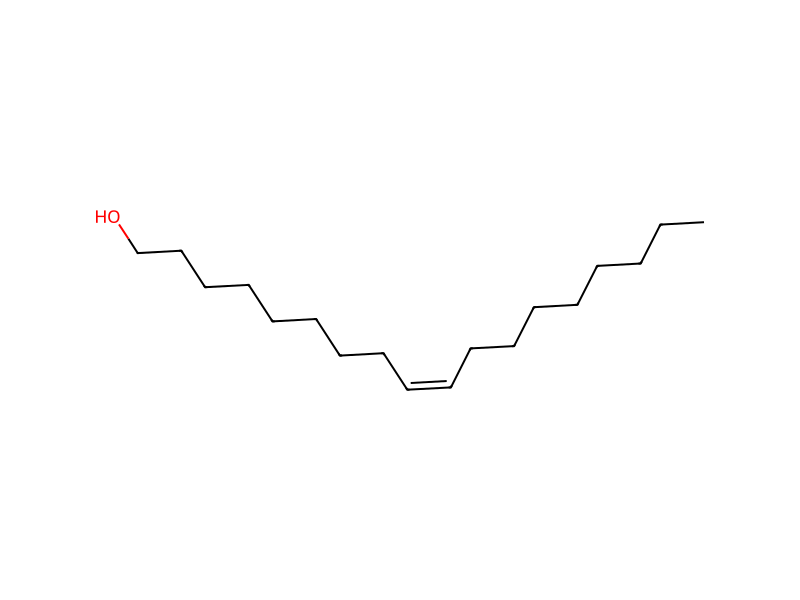
This example is a method of synthesis for inventive compound no. 3508. Triphenylphosphine (5.24 g, 20 mmol) was added incrementally to a solution of oleyl alcohol (5.37 g, 20 mmol) and carbontetrabromide (6.63 g, 20 mmol) in 400 ml of dichloromethane, the resulting reaction mixture being stirred for an hour at room temperature. Removing the solvent under reduced pressure, left a residue, which was extracted with three 200 ml aliquots of hexane. Further purification by flash chromatography over silica gel using a hexane eluant produced 5.82 g of 1-bromo-9-octadecene (88% yield).
Workup
- customa method of synthesis for inventive compound no
- customthe resulting reaction mixture
- customRemoving the solvent under reduced pressure
- waitleft a residue, which
- extractionwas extracted with three 200 ml aliquots of hexane
- customFurther purification by flash chromatography over silica gel using a hexane eluant
Sources & evidence
- ORD record
- ord-69c9a41993d1444ba1f7127159f119a3
- Source dataset
- uspto-grants-1998_09
- Patent number
- US05807862
Reaction notes
Loading…