Water → HCID 18973414, compound
Reaction equation

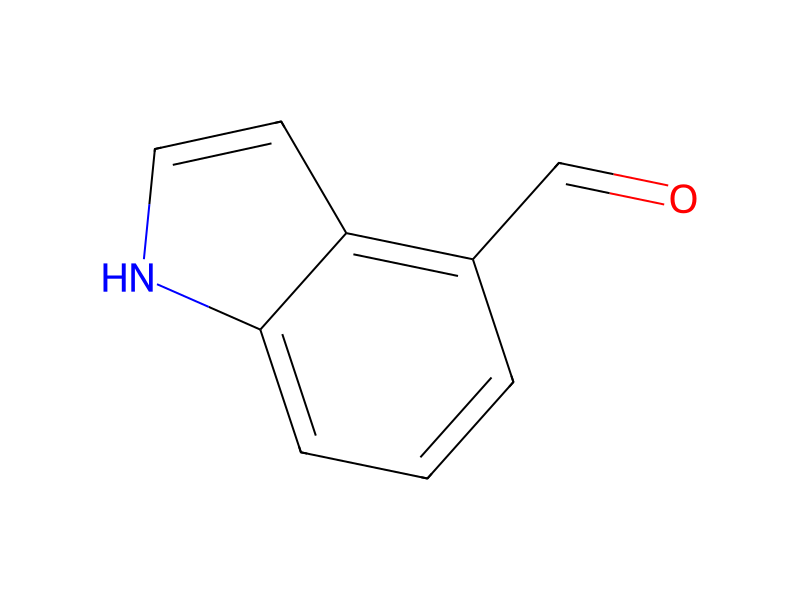
[NH:1]1[C:9]2[CH:8]=[CH:7][CH:6]=[C:5]([CH:10]=[O:11])[C:4]=2[CH:3]=[CH:2]1.[H-].[Na+].[C:14]1([CH3:23])[CH:19]=[CH:18][CH:17]=[C:16]([N:20]=[C:21]=[O:22])[CH:15]=1.O>CN(C)C=O.CCCCCC.C(OCC)(=O)C>[C:14]1([CH3:23])[CH:19]=[CH:18][CH:17]=[C:16]([NH:20][C:21]([N:1]2[C:9]3[CH:8]=[CH:7][CH:6]=[C:5]([CH:10]=[O:11])[C:4]=3[CH:3]=[CH:2]2)=[O:22])[CH:15]=1Participants






Procedure
Indole-4-carbaldehyde (435 mg) was dissolved in 8 ml of dimethylformamide at room temperature under an argon gas atmosphere, then 126 mg of sodium hydride (content 60%) was added to the resulting solution and the mixture was stirred for 30 minutes, then 439 mg of m-tolylisocyanate was added thereto and the resulting mixture was stirred for one hour. The reaction solution was added to 50 ml of water followed by extraction with ethyl acetate (50 ml×2). The resulting organic phase was washed with water (50 ml×2), dried over anhydrous sodium sulfate and the solvent was removed by distillation under reduced pressure to give a crude product. This was subjected to silica gel chromatography (eluent: hexane/ethyl acetate=4/1) to give 736 mg of 1-(m-tolylcarbamoyl)indole-4-carbaldehyde as pale yellow crystals. The yield thereof was found to be 88%.
Workup
- stirringthe resulting mixture was stirred for one hour
- extractionfollowed by extraction with ethyl acetate (50 ml×2)
- washThe resulting organic phase was washed with water (50 ml×2)
- dry with materialdried over anhydrous sodium sulfate
- customthe solvent was removed by distillation under reduced pressure
- customto give a crude product
Sources & evidence
- ORD record
- ord-213ca568b87b47429d95804972a29a4f
- Source dataset
- uspto-grants-1998_09
- Patent number
- US05811439
Reaction notes
Loading…