1-Bromohexane → HCID 18973570, compound
Reaction equation

[NH:1]1[C:9]2[CH:8]=[CH:7][CH:6]=[C:5]([CH:10]=[O:11])[C:4]=2[CH:3]=[CH:2]1.[CH2:12](Br)[CH2:13][CH2:14][CH2:15][CH2:16][CH3:17].C(=O)([O-])[O-].[K+].[K+].[Cl-].[NH4+]>CN(C)C=O>[CH2:12]([N:1]1[C:9]2[CH:8]=[CH:7][CH:6]=[C:5]([CH:10]=[O:11])[C:4]=2[CH:3]=[CH:2]1)[CH2:13][CH2:14][CH2:15][CH2:16][CH3:17]Participants
Reactant 4



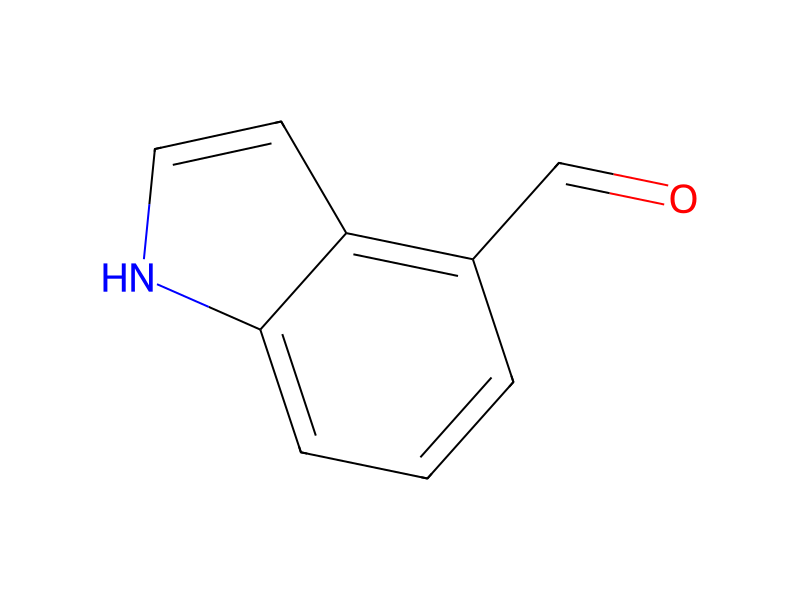
Product 1

Reagents, catalysts & solvents 1

Conditions
- Temperature
- 55 °C
Procedure
There were dissolved, in 26 ml of dimethylformamide, 2.00 g of indole-4-carbaldehyde and 4.64 g of n-hexyl bromide, followed by addition of 9.52 g of potassium carbonate and heating the reaction solution to 55° C. with stirring for 12.5 hours. The reaction solution was poured into 500 ml of a 10% aqueous solution of ammonium chloride followed by extraction with ethyl acetate (150 ml×3). The resulting organic phase was washed with a saturated common salt solution, dried over anhydrous sodium sulfate, followed by removal of the solvent through evaporation under reduced pressure. The resulting crude product was purified by silica gel column chromatography (hexane:ethyl acetate=10:1) to give 1.91 g of 1-hexylindole-4-carbaldehyde as a yellow oily substance. The yield thereof was found to be 61%.
Workup
- extractionfollowed by extraction with ethyl acetate (150 ml×3)
- washThe resulting organic phase was washed with a saturated common salt solution
- dry with materialdried over anhydrous sodium sulfate
- customfollowed by removal of the solvent through evaporation under reduced pressure
- customThe resulting crude product was purified by silica gel column chromatography (hexane:ethyl acetate=10:1)
Sources & evidence
- ORD record
- ord-2b56548b01c340f993ea47f71cbe2179
- Source dataset
- uspto-grants-1998_09
- Patent number
- US05811439
Reaction notes
Loading…